On-Target Earnings Structure in Sales Compensation
Misaligned pay mixes and unrealistic quotas tank sales compensation plans.

Pay mix, the ratio of guaranteed base to at-risk variable compensation, is the first structural lever a compensation designer pulls. Before quota is set, before accelerators are debated, that split between fixed and variable income already tells a rep what the company believes their job actually is.
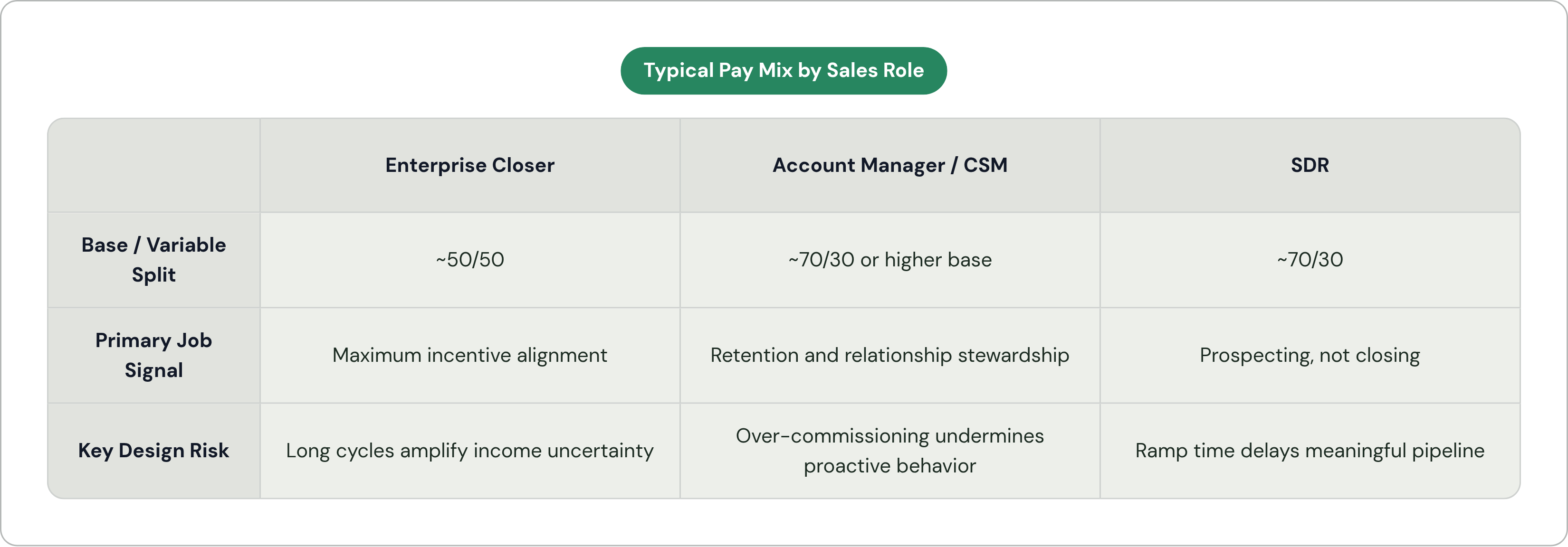
A 50/50 split says hunt, and we'll pay disproportionately for it. A 70/30 split says we value consistency and relationship stewardship over pure closing velocity. Neither is wrong. What's wrong is applying one to a role that demands the other, and I've watched that mistake play out enough times to recognize it within the first five minutes of reading a plan.
The reference points across common role types aren't complicated once you've seen enough of them. Experienced enterprise closers in predictable deal cycles typically land at or near even splits, where maximum incentive alignment is the design goal. Customer success and account management roles skew toward heavier base because retention behavior is the primary job, and you can't commission your way into proactive relationship management the same way you can into a new logo pipeline. SDRs land around 70/30, given the prospecting-not-closing nature of the role and the ramp time required before any rep can generate pipeline worth measuring.
Here is where misapplication does real damage: a 50/50 mix on an 18-month enterprise sales cycle leaves reps facing prolonged income uncertainty that has nothing to do with their effort or competence. The mix is misfiring relative to the selling environment, and no downstream design refinement corrects for that after the fact. Reps feel the mismatch immediately. The best ones act on it quickly.
Pay mix is also a signal candidates use to assess how realistic the variable portion is, which is why it must be paired with honest quota attainment data. A high OTE with an 80/20 mix and a 30% attainment rate isn't a compensation plan. It's a recruiting document that creates a legal and relational liability the moment someone actually starts the job.
Why the Quota-to-OTE Ratio Is Where Most Structural Problems Start
OTE is only meaningful if the quota it hangs on is reachable. A quota set too high converts the variable component from a motivational mechanism into a theoretical construct, a number that exists on paper but doesn't function in the field.
The attainment picture across the industry has deteriorated materially. Per Fullcast's 2026 Benchmarks Report, more than 78% of sellers missed quota in the reporting period. That figure isn't primarily a morale story. It's a structural indictment of how quotas are being set relative to what reps can realistically achieve. SDR attainment is similarly grim; the same report shows average attainment sitting well below target, meaning the median SDR earns noticeably less than their stated OTE over the course of a year.
The more troubling pattern is directional. OTE targets have continued rising across the industry even as attainment rates fall, according to the same Fullcast report. Two lines moving in opposite directions at that magnitude tell you something specific: quota-setting has become decoupled from ground-level performance data. When OTE goes up and the share of reps reaching it goes down, the stated figure stops functioning as a benchmark and becomes a number on a slide deck.
The downstream consequences compound. Reps stop treating the comp plan as a behavioral guide once 100% feels structurally out of reach. Finance models commission expense against attainment assumptions that don't reflect reality, which distorts headcount planning and revenue forecasting in ways that surface at the worst possible moment. Top performers do the math, often within their first year, and leave when the calculation doesn't hold. I've seen entire mid-market teams turn over inside eighteen months for exactly this reason, with leadership genuinely surprised each time.
Data-driven quota setting, grounded in historical win rates, territory potential, average deal size, and seasonal variation, is how the ratio gets calibrated rather than guessed. Ramp periods add a necessary layer of nuance that many plans handle informally, which is a mistake. A new rep who can't hit quota in the first six months because they're still building pipeline isn't underperforming. They're in a ramp window, and the plan design should say so explicitly, with adjusted quotas or guaranteed draw components that make the OTE achievable during onboarding. An informal understanding isn't a plan. It's a setup for a dispute.
What Happens Above and Below 100%: Accelerators, Tiers, and the Cost of Caps
Commission structures fall into three practical forms. Linear plans pay a constant rate per dollar sold; they're simple to administer but don't differentiate between a rep at 80% attainment and one at 130%. Tiered plans increase commission rates at defined thresholds, rewarding incremental progress and keeping mid-level performers engaged. Accelerated plans step rates up sharply above 100%, with the design goal of making overperformance feel financially worth chasing rather than just professionally satisfying.
Accelerators exist because without them, high performers have no material incentive to push past quota. They've hit the target. Additional effort produces no additional reward. The behavioral consequence is predictable, and it happens reliably.
Capping earnings above a threshold communicates something a company usually doesn't intend to say out loud: that it doesn't actually want to pay for its best performers' best work. Caps are a reliable mechanism for losing top talent or, more insidiously, for training reps to hold deals from one period to pad the next. I've watched that sandbagging behavior emerge inside a single quarter once a cap goes in. The short-term financial relief is real; so is the behavioral distortion, and the math rarely favors the cap over a full cycle.
Below-quota mechanics are less discussed and deserve more scrutiny. Some plans use decelerators, paying lower commission rates below a defined threshold, to signal that partial attainment isn't cost-neutral for the business. The risk is demoralizing the reps who are close but not there yet, precisely the population most likely to respond to a well-calibrated incentive. That design requires genuine care, not a policy decision made in a finance meeting without sales input.
The behavioral economics underlying all of this is well-established. Kahneman and Tversky demonstrated in their 1979 paper "Prospect Theory: An Analysis of Decision under Risk," published in Econometrica, that people weight the pain of losing expected income more heavily than the pleasure of gaining an equivalent amount. That asymmetry shapes how reps experience every tier boundary and threshold in a commission plan, which is why the path from 80% to 100% matters as much as the accelerator above 120%. Both ends of the curve demand deliberate attention.
One constraint bounds every design choice: complexity. Every additional tier, kicker, and accelerator adds cognitive load. A plan a rep can't mentally model during a deal conversation won't drive the behavior it was designed to produce. Structural simplicity isn't an aesthetic preference. It's a functional requirement, and the plans that fail in the field are most often the ones that were overbuilt in a conference room by people who weren't the ones carrying the quota.
The Three Documents Every OTE Structure Needs to Function in Practice
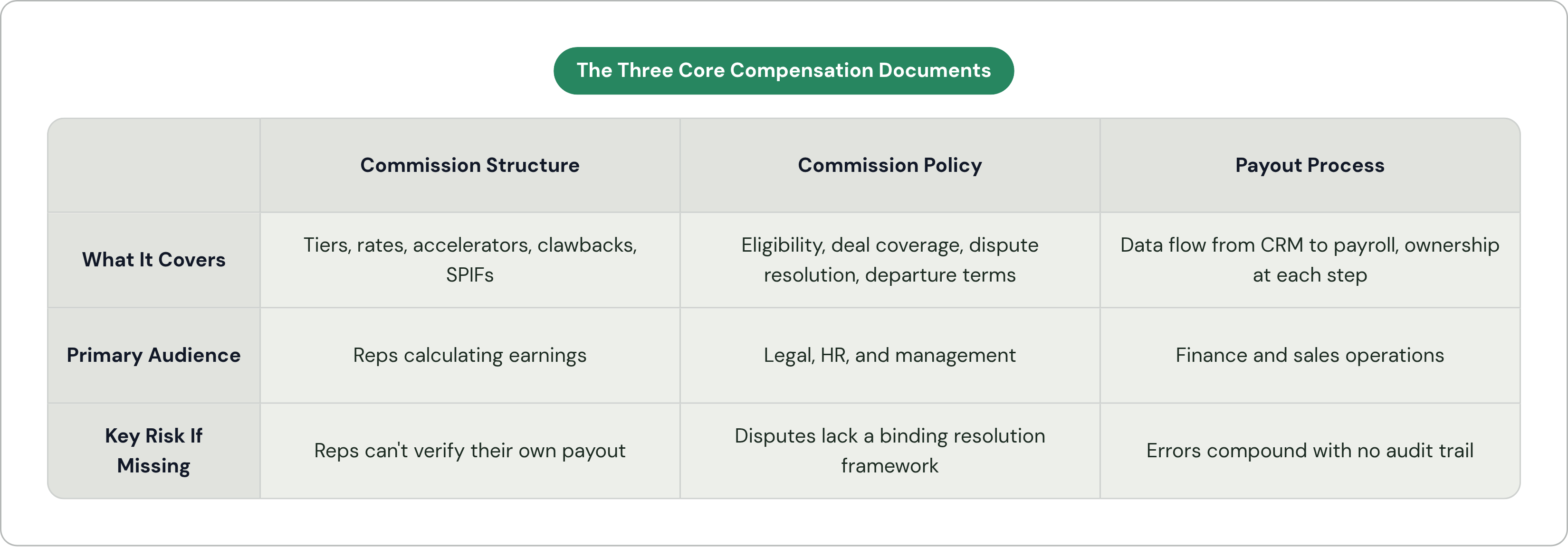
Most companies either collapse these into one document or produce none of them with sufficient rigor. Each serves a different function. Conflating them is a root cause of the disputes and eroded trust that surface six months after a plan launches, usually on a Tuesday when someone opens their commission statement and the number doesn't match what they calculated.
The commission structure is the math, covering tiers, rates, accelerator thresholds, clawback conditions, and SPIF terms. It answers how much a rep earns under every attainment scenario. The commission policy is the rules document, covering eligibility criteria, deal coverage definitions, payout timing, what happens upon departure, and how disputes get resolved. The payout process is the operational workflow, covering how data moves from CRM to calculation to approval to payroll, and who owns each step. These documents serve different audiences and answer different questions. They shouldn't be the same document.
Vague plan language is a root cause of disputes, not an administrative oversight. Terms like "net revenue" and "booking" require precise definitions. Does revenue include discounts? Is a booking recorded at contract signature or at first invoice? The ambiguity that feels acceptable when a plan is written becomes a legal and relational problem when a rep's commission check reflects a different interpretation than they held going into the quarter. I've seen that specific disagreement over "booking date" consume more management hours than anyone wanted to count.
Clawbacks introduce a legal dimension that many companies address after the fact rather than in the original document, which is exactly the wrong sequence. Written authorization is required in most U.S. jurisdictions to recover commission from a current employee. California imposes significant restrictions on wage deductions, making clawback recovery difficult to execute without proper documentation. The policy document isn't optional where clawbacks exist; it's the legal foundation for the recovery mechanism.
Pay transparency regulations in California, New York, Illinois, and other states have expanded materially through 2025 and now require upfront disclosure of compensation ranges and commission structures. The policy document has crossed from internal reference to compliance requirement in a meaningful portion of the U.S. labor market. Companies treating it as optional are accumulating regulatory exposure quietly.
A practical diagnostic: if a new team member can't calculate their own commission on a sample deal without asking for help, the structure is too complex to function as designed. Ramp-period documentation deserves the same rigor as the main plan; draw arrangements and adjusted quota terms must be explicit, because informal understandings generate disputes at the ramp window's close with a regularity that should embarrass any team that's been through it more than once.
Why Spreadsheet-Based Commission Calculation Undermines a Well-Designed OTE Structure
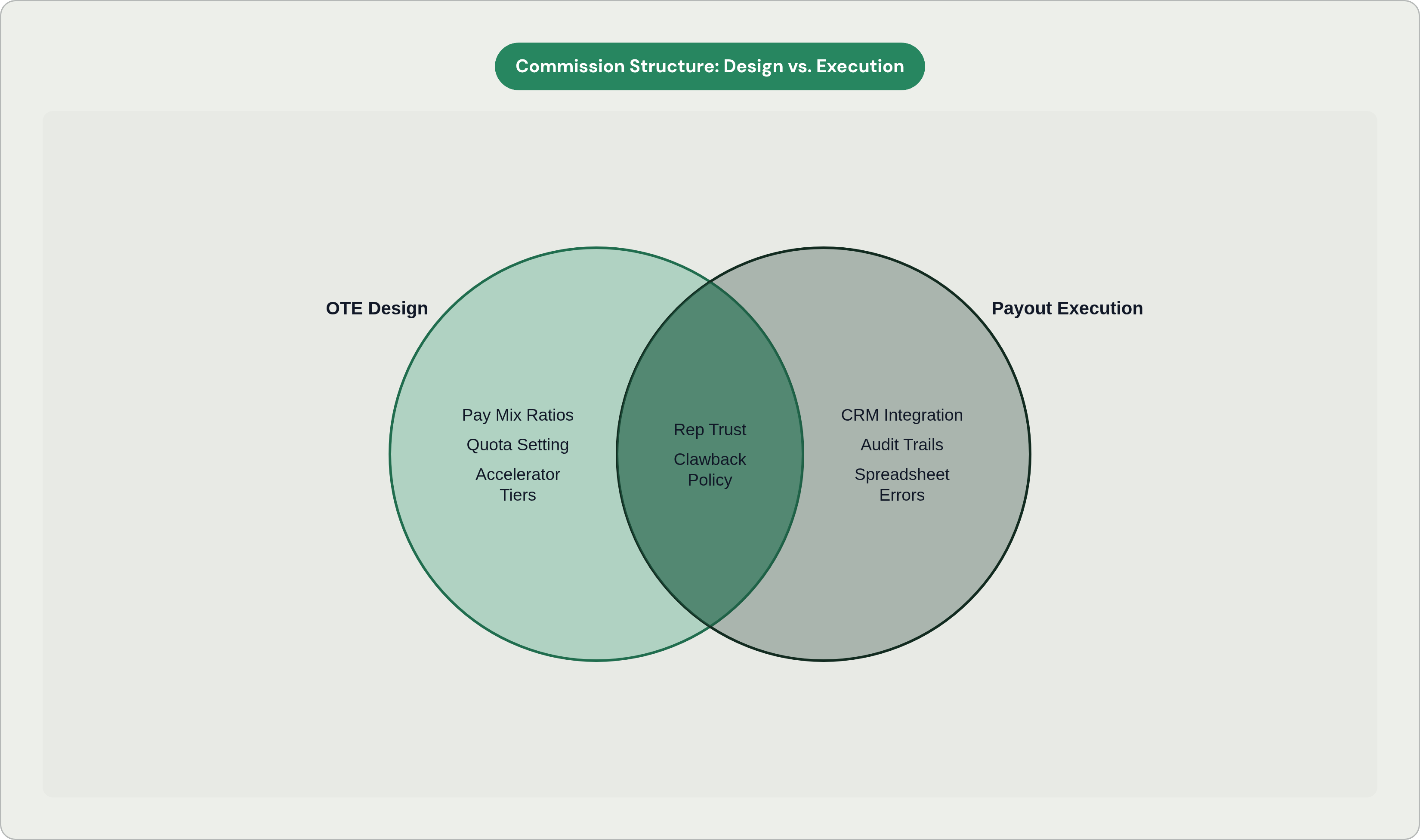
The calculation layer is where OTE either delivers on its promise or fails quietly. Design quality is irrelevant if the payout is wrong. Spreadsheets remain common for commission calculation despite failure modes that are predictable, documented, and costly.
The error sources specific to OTE complexity aren't exotic. Multi-tier and accelerator structures are precisely where formula errors compound: a misplaced threshold or incorrect rate in one tier propagates across every rep attaining above that level. Clawbacks and mid-period plan changes require retroactive adjustments that are straightforward to miss in a spreadsheet with no formal audit trail. Data entry errors, reversed figures, mismatched deal records — these remain invisible until a rep spots the discrepancy and files a dispute, at which point finance and operations must reconstruct the calculation from whatever version of the file they can locate. That archaeological exercise isn't a good use of anyone's time, which is the gap Quota Queue, a spreadsheet-free commission calculation platform that takes companies from raw deal data to payroll-ready commission statements, was built to close.
The cost is quantifiable. Research cited by Sales Cookie found a 4.2% overpayment rate in manual commission calculations among North American SMB sales managers. On any material commission budget, that rate represents substantial unrecovered expense each year, independent of the time finance and operations teams spend on data gathering, formula verification, and dispute resolution. That time comes directly from plan optimization and strategic forecasting work, not from slack capacity.
Data security adds a dimension that's consistently underweighted until something goes wrong. Commission files are personally identifying, financially material, and payroll-bound. A spreadsheet distributed to the wrong recipient is a documented failure mode with real consequences, and the risk compounds with every rep added to the team.
That scaling dynamic is the structural problem with spreadsheet-based commission management. The operational cost grows faster than headcount. A team managing commissions on spreadsheets at ten reps faces a qualitatively different problem at forty. A company that invests in careful OTE design and then runs the output through a process that corrupts it at every calculation step has built a liability. The plan is good. The execution undermines it on a predictable schedule.
What Commission Software Actually Changes About How OTE Delivers in Practice
Commission software doesn't replace OTE design. It enforces it. The tiers, accelerators, clawback conditions, and threshold definitions established in the plan become rules the system applies consistently, rather than formulas someone must remember to update correctly each period under deadline pressure.
CRM integration addresses the most common source of input error by closing the data-entry gap. Deal records flow directly into commission calculations without manual re-entry, removing the failure point that produces most discrepancies. Locked pay periods and audit trails address the version-control problem: every calculation is traceable, approvals are logged, and prior periods can't be accidentally overwritten during a current-cycle update. These aren't sophisticated capabilities. They're table stakes that spreadsheets structurally can't provide.
AI-assisted plan extraction, the ability to read an existing compensation plan document and translate its rules into a structured system configuration, reduces setup friction without removing the human review step that accuracy requires. It's a practical capability for teams migrating off manual processes with complex legacy plan language. Any team treating extraction output as final without reviewing edge cases is making a mistake they'll discover on payout day.
Rep-facing earnings visibility is the most direct behavioral benefit. When reps can see their quota progress, deal-level statement detail, and projected payout in real time, shadow accounting becomes unnecessary. The motivational alignment the OTE structure was designed to create actually functions, because reps can see and trust the mechanism that produces their check. Per Gartner's 2025 data, a substantial majority of large enterprises have already adopted specialized sales compensation technology with embedded analytics. For growing teams, the question isn't whether purpose-built software represents the standard. It's how long manual management remains defensible given the plan complexity and headcount the team is carrying.
For teams evaluating a move off spreadsheets, the field includes several options worth examining. Xactly and Varicent serve larger enterprise environments with deeper analytics and workflow capabilities. Everstage and Palette are worth evaluating for mid-market teams seeking configurability without a lengthy implementation. Evaluation criteria should weight CRM compatibility, plan configuration flexibility, audit trail capability, and pricing model against team size and plan complexity. The correct answer is the platform that enforces the plan as designed and produces a payout the rep can verify without calling anyone.
How Reps Experience OTE When the Structure Is Honest and the Calculation Is Trustworthy
A significant share of reps run parallel commission tracking to verify what they'll be paid. That's a rational response to working inside a process they don't fully trust, not a character flaw. Shadow accounting is a symptom of structural failure, and the fact that it's nearly universal in organizations with manual payout processes tells you exactly what those reps believe about the plan they're on.
The motivational logic of OTE only activates when reps believe the number is real: that hitting quota will produce the stated payout, that exceeding it will produce the accelerated rate, and that neither outcome will be subject to dispute, delay, or a quiet reinterpretation of what "net revenue" means this quarter. That belief is built through structure and process, consistently applied over time. It's not established by a well-worded offer letter.
Pay transparency requirements across multiple states have added a compliance dimension to what was previously only a trust question. Reps in California, New York, Illinois, and elsewhere have legal standing to expect documented commission structures. The obligation to be clear isn't purely ethical; it's increasingly statutory, and the enforcement posture of labor regulators in those states has sharpened materially over the past several years.
What makes OTE trustworthy in practice comes down to three things. Quota must be set at a level the data shows is achievable for a typical rep, not just the top decile. The calculation process must be auditable and explainable at the deal level. Reps need real-time visibility to track their own progress without maintaining a parallel spreadsheet. None of this is aspirational. All of it is achievable. The sales organizations that get all three right spend far less time managing attrition, disputes, and the slow erosion of confidence that accumulates when compensation design is treated as a formality and payout execution is treated as someone else's problem.