Sales Compensation Plan Documentation and Rep Sign-Off
Clear payout rules and rep sign-off prevent compensation disputes before they start.

A sales compensation plan document is only as good as the clarity it creates and the agreement it captures. Get the document right and most disputes never happen; get it wrong and you've built a slow-motion trust problem that resurfaces every single pay cycle.
The plan document is the one authoritative reference for how a rep earns money: base, variable, quotas, crediting rules, accelerators, clawbacks, payout timing. It has to work for three readers who need very different things from it. The rep needs to plan a quarter around it, the manager has to explain it without guessing at the answer, and finance and legal need something they can defend if a dispute ever climbs past the sales floor. None of this is a one-time exercise. Plans get revised mid-year, at fiscal year start, in response to a market shift or a quota that turned out to be wrong the moment it was set. A document written once, filed as a PDF, and forgotten is already stale the second the business moves.
US companies pour enormous sums into sales compensation every year, which makes the document governing that spend one of the more consequential pieces of paper a company produces. Research from WorldatWork and Everstage found most companies are dissatisfied with their own comp plans, and they point to the same two culprits every time: unclear payout rules and poor communication. That's the plan failing at the one job it has, which is removing ambiguity before it curdles into a dispute.
The twelve elements a legally and operationally complete plan document needs to include
Sales Comp Lab published a research-based guide in December 2025 laying out twelve elements a plan letter needs before it counts as complete and legally defensible. Plan period, with effective dates and fiscal year scope. Role eligibility, naming which roles and tiers the plan covers. Pay mix and OTE summary, showing the base-to-variable split and total at-plan earnings. Quota and attainment method, explaining how the number got set and how progress against it actually gets measured.
Rates and accelerators come next, laid out tier by tier, with the exact trigger condition for each accelerator spelled out rather than implied. Definitions for terms like "closed," "credited," and "revenue" matter more than people expect, because these words mean different things at different companies, and the document has to pick one meaning and hold it. Crediting rules address who gets the credit when more than one rep touches a deal, which is the single most common source of internal arguments I've watched play out. Payout timing, partial payments, and clawback conditions cover when money moves and when the company can legitimately take it back.
Round out the list with a dispute process on a defined clock, a plan modification clause with audit rights (because the company will need to adjust things mid-year, and that right has to be written down in advance rather than asserted after the fact), termination rules for unvested or unpaid commissions, and the acknowledgment signature itself.
Each of these closes a specific gap. Crediting rules kill split-deal arguments before they start, clawback terms stop a rep from getting blindsided by a recoupment nobody warned them about, and the dispute window stops someone from resurrecting a claim about a deal that closed two years ago. Skip even one of these twelve and that's precisely where the disputes cluster, because reps and administrators each fill the silence with their own interpretation, and those interpretations almost never match.
How poor document structure undermines even technically correct plans
Here's a failure mode that has nothing to do with whether the numbers are right. The document gets written by attorneys, for attorneys, and definitions and legal conditions land on page one, before the rep has any idea how the plan actually pays them. Nobody sits down and reads it from the rep's seat, because that discipline costs time most teams never budget for. The result, unintentionally, reads like the company is looking for reasons not to pay.
Flip the order and the document works. Earnings logic goes first: base, OTE, quota, rates, the stuff a rep needs to actually plan a quarter. Terms, conditions, and dispute language move to a clearly labeled section further down, present when needed but not blocking the path to the commission rate. Organizations that get this right treat plan letters the way a product team treats documentation: version-controlled, tested on real readers, dense with definitions, built for edge cases instead of written as though every deal closes clean and every quarter goes to plan.
Here's the test I use. A rep should be able to read the document and know how they get paid without pulling their manager into a side conversation. Need a spreadsheet and a manual calculation just to follow the logic? The document already failed, and that's true independent of whether the plan underneath it is fair.
Accelerators need extra care here, because they're simultaneously the most motivating part of a comp plan and the most argued-over. Retroactive rate recalculations are genuinely hard to follow in prose alone. A sentence saying commissions above 120% of quota recalculate at a higher rate for the entire period, not just the incremental revenue, reads completely differently depending on whether there's a worked numerical example sitting next to it. There should be one, every time.
Why timing the document's release matters as much as its content
Best practice puts the finalized plan in reps' hands at least 30 days before the effective date, usually the start of the fiscal year. Works Councils and local labor law push that window earlier in some jurisdictions and require a formal acceptance process, which means legal review before distribution isn't optional there; it's the floor.
Late delivery is a practical problem before it's anything else. Reps end up selling under terms they haven't formally agreed to, and untangling a dispute about a deal closed before sign-off gets harder the longer it sits. Timing failures create a trust problem on top of the practical one. A rep who gets their plan document in week six of the quarter has every reason to wonder whether the rules were locked before their results came in, or after.
The order of the rollout matters as much as the date on the calendar. Managers need to see and understand the plan before their reps do, because they're the ones fielding questions in real time, and they can't do that credibly while learning the plan alongside the people they manage. Individual one-on-ones after the group rollout give reps a private channel to raise something they wouldn't say in front of peers. Following those conversations up in writing builds a record of what actually got explained and what actually got acknowledged, and that record matters far more than most people realize until the first dispute lands on someone's desk.
What rep sign-off actually accomplishes — legally and operationally
A signed compensation agreement functions as a contract. It records that the rep got the plan, had a real chance to ask questions, and accepted the terms as written. California and New York make written acknowledgment a legal requirement outright. Even where it isn't mandated, the same practice protects both sides: the company can show the rep knew the rules going in, and the rep can point to exactly what they agreed to if the company later tries to move the goalposts.
The acknowledgment page itself typically confirms three things, and only three: the rep received a copy of the plan, had the chance to ask questions, and understands the terms as written. Counter-signature from the immediate manager and the next-level manager, followed by HR filing the signed document in the rep's personnel record, builds the chain of accountability that makes this enforceable instead of ceremonial.
Some organizations hold commission payouts until acknowledgment is complete. It's a blunt instrument. It also works, and it tells you something about how seriously that organization takes the sign-off step. Legal review before distribution is the standard, full stop, because once a rep signs it, the document binds both parties. That cuts both ways, and it should.
The mechanics of collecting signatures at scale without losing weeks to the process
Two approaches show up in practice. One embeds a signature line directly in the plan document, completed through an electronic signature tool like DocuSign. The other generates an individual incentive plan statement listing the rep's specific quota, OTE, base, and variable, and collects sign-off there instead; signing the statement also acknowledges the underlying plan description.
The individual statement approach tends to win out when commission software is already generating each rep's personalized numbers, because the statement becomes the natural place to collect a signature. It's the rep's own figures, translated into their own situation, not a generic form.
Manual tracking falls apart fast once a team grows past a handful of reps. Who's signed, who hasn't, and which version of the plan they signed against are three separate things to track, and a spreadsheet trying to hold all three drifts out of date within a cycle or two, sometimes faster. One finance leader I know saved several hours a cycle just by automating signature collection through commission software instead of chasing DocuSign links by hand. Version control is the piece manual workflows botch worst. Amend a plan mid-year and the organization needs a clean record of exactly which version each rep signed and when; a spreadsheet tracking that by hand is itself a likely source of the next dispute. This is the exact accountability gap Quota Queue's workflow is built to close: locking pay periods, generating rep-level statements automatically, keeping an audit trail of approvals so nobody has to reconstruct who signed what from memory six months later.
How documentation gaps translate into commission errors and the disputes that follow
When crediting rules, accelerator thresholds, or clawback conditions aren't pinned down in the document, someone still has to make the call at payout time. Usually that's a commission administrator, filling the gap with judgment calls that drift from pay period to pay period and rep to rep, because there's no written rule anchoring the decision.
Benchmark data from Sales Cookie puts 4.2% of commission payouts as later-identified overpayments. That's not a rounding error. It's recoupment friction, rep distrust, and often a clawback dispute that never had to happen. Run that math on a $10 million annual commission expense at even a 2% net error rate and the direct cost lands around $200,000 a year, per Sales Cookie's May 2026 figures, before anyone counts the hours spent finding and fixing the errors in the first place.
Retroactive accelerator recalculations are the single most error-prone step in manual commission processing, and that's not a coincidence: it's also the scenario where precise documentation matters most. Exactly how the accelerator triggers, and against what revenue base, needs to be spelled out in a way that doesn't leave room for two reasonable people to read it two different ways. Disputes cost more than the dollar amount in question, too. Reps pulled into reconciliation meetings aren't selling, and that lost time compounds across a team over a year. Trace most commission disputes back far enough and they turn out to be arguments about interpretation, not math, and interpretation disputes exist because the plan document never defined the term everyone's fighting over.
Shadow accounting as the signal that documentation and transparency have failed
Shadow accounting is what happens when reps keep their own parallel commission tracking, outside the official system, to check what they believe they're owed. Sales Cookie's research puts the number at roughly three in five reps doing this. Distrust isn't really the root cause. Missing information is: the details a rep would need to verify the official number simply aren't available to them in a form they can check.
The time cost is real. Reps running shadow books burn hours a week on reconciliation that generates zero revenue, and for a mid-sized sales team that adds up to thousands of hours a year, according to Performio. Trace the root cause and it lands on one of two documentation failures almost every time. Either the plan document never defined the calculation precisely enough to check independently, or the rep never got deal-level visibility into how the official number was reached, which leaves reconstruction as the only option left.
Watch shadow accounting closely, because it's a leading indicator, not a curiosity. Reps who can't reconcile their own earnings stop trusting the organization that pays them, and per WorldatWork, commission disputes are a documented trigger for voluntary resignation. Telling reps to trust the number doesn't fix this problem; building a document and a system precise enough that they can verify the number themselves does.
What a rep-facing statement needs to show alongside the plan document
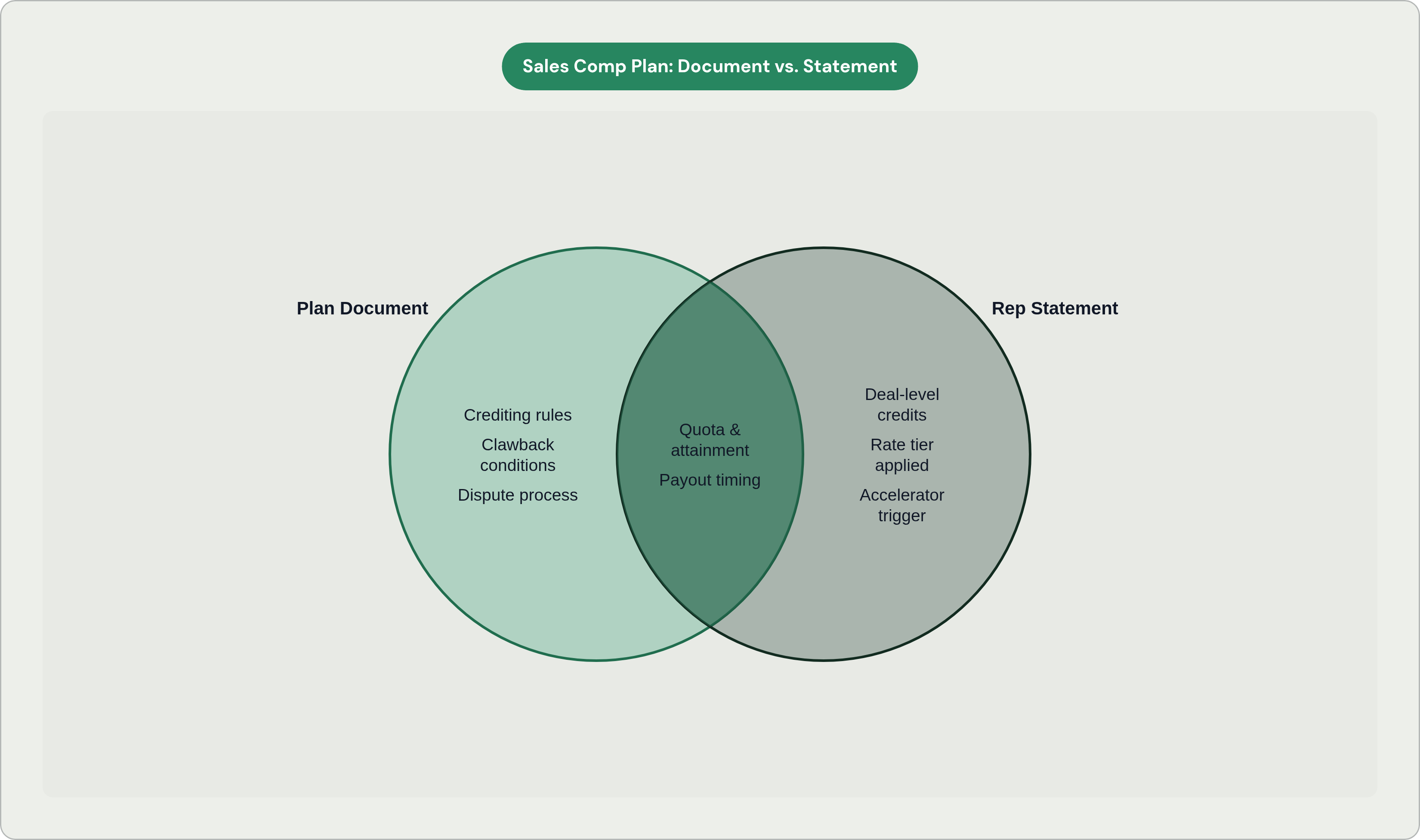
The plan document sets the rules. The individual statement applies those rules to one rep's actual numbers for one specific period. Mixing the two up is where a lot of the friction between reps and finance actually comes from.
A rep-facing statement needs to show which deals were credited and the revenue recognized against each one, how attainment was calculated against that rep's specific quota, which rate tier applied and why that tier rather than the one above or below it, whether an accelerator triggered and against what revenue base, any clawbacks or SPIFs layered on top, and the net commission figure with a visible line showing how it flows into payroll.
Give reps that level of deal-level detail and shadow accounting loses its reason to exist. The official record now answers the exact question the rep was trying to answer alone at 9pm with a spreadsheet. The statement doubles as a running audit trail, locked and versioned against a specific pay period, so if a dispute surfaces weeks later, both sides are looking at the same documented record instead of arguing from memory. Producing that level of deal-level accuracy for every rep, every period, at real scale, takes software built to calculate and display it, not a template someone patches by hand every month.
What good documentation and sign-off practice looks like end to end
Put the full workflow together and here's what it looks like. Draft the plan document with all twelve elements, written from the rep's seat, earnings logic first, legal conditions clearly labeled but not buried in the lead. Run it through legal review before distribution, since the moment it's signed it becomes a binding contract. Send it to managers first, at least 30 days ahead of the effective date, so they can field questions instead of learning the plan in real time alongside their reps.
Hold individual rep conversations before the formal sign-off and follow each one up in writing. Collect signatures through an electronic signature tool or through commission software's built-in verification, generating each rep's individual statement with their own figures at the same time. Counter-sign through the management chain, file with HR, and record exactly which version of the plan got signed. Deliver deal-level statements every pay period, locked and versioned against the signed plan, so the document's promises actually get kept instead of just written down somewhere. When a mid-year amendment lands, re-run the sign-off step rather than assuming the original signature still covers it; version the new document and keep a clear record of what each rep agreed to and when.
Every one of these steps is doing the same job: turning a written rule into a shared, verifiable, enforceable agreement, then backing it with enough calculation transparency that a rep's signature means something more than a box checked for compliance. Organizations that treat documentation and sign-off as paperwork will keep having disputes no matter how well-intentioned the comp plan underneath it is. Organizations that treat it as the foundation of the whole comp relationship close the gap between what reps are owed and what they believe they've received, and that gap is a harder problem to solve than getting the math right ever was. Commission software that locks pay periods, keeps an audit trail, generates rep-level statements, and supports a real sign-off workflow, the kind Quota Queue offers, is what makes this level of discipline sustainable once the sales team stops being small enough to run on trust alone.