When to Budget for Commission Software vs Delay the Investment
Spreadsheets fail silently once commission complexity and headcount surpass their scaling limits.

What spreadsheets can handle, and where that ceiling sits
The right time to budget for commission software is not when the finance team feels overwhelmed. It is when spreadsheet-based commission tracking starts generating measurable, recurring cost, in dispute hours, in overpayments, in reps who stop trusting their paycheck. Most teams misjudge this timing because they watch the wrong signals, and watching the wrong signals produces the wrong call almost every time.
Spreadsheets work fine at a certain scale and a certain level of plan complexity. Past that point, spreadsheets fail quietly rather than degrading gracefully, and a rushed migration late in the year causes a dispute weeks later that nobody can fully explain.
A team of five to ten reps on a single flat-rate structure, with no mid-year changes, no splits, no accelerators, can run commissions in a spreadsheet without much drama. One person owns the file. The formulas are simple enough to check by eye in a few minutes. Commission spend is small enough that even a 3 to 5% overpayment loss doesn't move the needle on the P&L. That setup is defensible.
Growing headcount and plan variety raise the dispute hours and rebuild time visible in that ceiling. Spreadsheets start straining around 25 reps once multiple plan types enter the mix. As headcount climbs toward and past 20 reps with multiple plans, commission admin increasingly stops being something squeezed in between other work and starts consuming a meaningful share of someone's week. By 75 reps, especially with mid-year plan changes layered in, spreadsheets don't just slow down, they start producing wrong numbers quietly, and nobody notices until a rep flags a payout that doesn't match their own math. Treat these as directional breakpoints, not hard thresholds: every org's plan complexity shifts the line.
The reason sits in what a spreadsheet actually is. Formulas live inside individual cells, not in reusable code, so every change has to be manually propagated across however many rows and tabs exist. There's no native way to handle a variable that changes mid-quarter, like a rep's rate shifting after a promotion. There's no snapshot of what a calculation looked like at a given moment, so reconstructing what the spreadsheet said in March, after April's edits, is often impossible. There's no real data model pulling from CRM, ERP, and HRIS at once, so someone ends up stitching sources together by hand. And there's no audit log, so tracing a wrong number takes archaeology instead of a quick lookup. A better template does not fix any of this; the problem is baked into the format itself. It is baked into the format itself.
The signals that indicate spreadsheets have become costly, not just annoying
Annoyance and cost get treated as the same thing far too often, and that confusion is how teams end up delaying too long or buying too early. An annoyance is inconvenient but contained: a formula that needs a manual tweak every quarter, a file that takes a few extra seconds to open. A cost signal does real financial or organizational damage, recurring, whether or not anyone happens to be complaining about it yet.
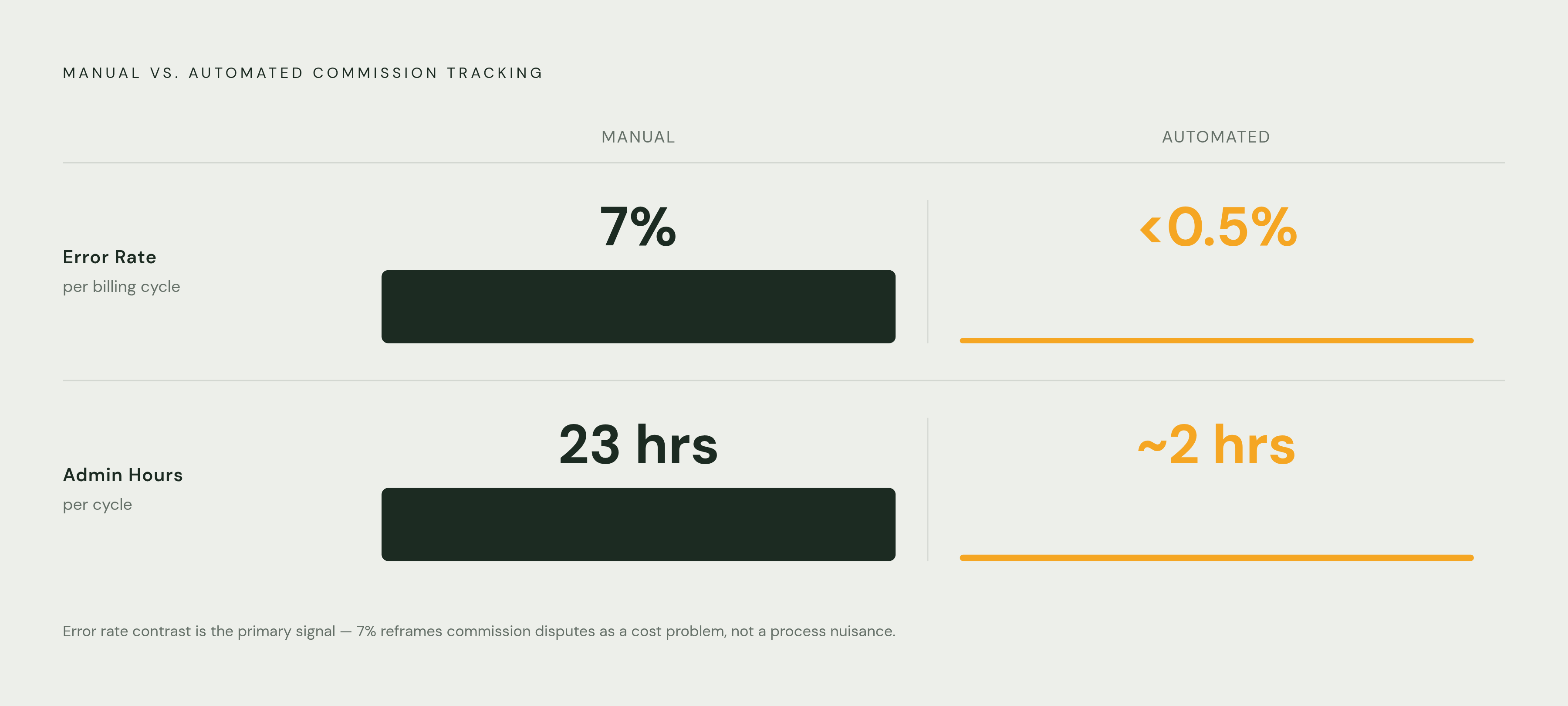
Calculation errors are the clearest of these signals. Companies running commissions manually tend to lose 3 to 5% of total incentive compensation to overpayments alone. On a meaningful annual commission spend, that is real money vanishing every year with no line item calling it out. The broader error rate across manual processes runs closer to 7%, against well under 0.5% on modern automated platforms. Across the industry, the majority of companies, by some measures a large majority, fail to pay commissions accurately in any given cycle. Inaccuracy is the default condition in manual systems. It is the default condition.
Ask a concrete question here: has a payout dispute in the last two quarters required opening the spreadsheet and retracing the logic line by line? If that has happened more than once, the system has already told you something about its own reliability.
Administrative time is the second signal, and finance usually notices this one first. Reconciliation and dispute resolution on a manual process tends to consume roughly three full working days each cycle, somewhere near 23 hours, against significantly fewer hours on a dedicated commission platform. That is most of a work-week, every cycle, spent on labor that produces no new revenue and exists purely to catch mistakes the tool itself introduced. Once commission administration eats more than a full business day per cycle, "it's just a spreadsheet" has already stopped being an accurate description of the cost.
Plan complexity outpacing the tool is the third signal, and it compounds in a way the first two don't. Tiers, accelerators, splits, clawbacks, SPIFs: each one stacks a new layer of formula risk on the last, and the layers interact in ways that get harder to audit the more of them pile up. High-growth companies routinely move from a single AE plan to somewhere between eight and fifteen distinct incentive structures within about eighteen months of scaling. That is the normal trajectory of a sales org segmenting its motion.
Rebuilding a spreadsheet for a mid-year plan change typically takes one to three weeks. Reconfiguring the same change in dedicated commission software takes one to three days. A growing org runs through several plan changes a year, and multiplying that gap by each one makes the time cost compound rather than add up linearly. A territory shift or a quota change should mean updating a variable and moving on, not rebuilding the spreadsheet from scratch. If it means the latter, the tool has already fallen behind the business it is supposed to support.
When delay is still a defensible call
Not every team needs to buy software this quarter, and pretending otherwise does a disservice to the teams for whom the math genuinely doesn't work yet. Delay is defensible when the cost signals above genuinely haven't materialized, not when they have materialized and simply haven't been tallied.
Waiting makes sense when headcount is stable and isn't likely to outgrow the spreadsheet's viable range in the next two or three quarters. It makes sense when the plan design stays genuinely simple, flat rate, one structure, no splits or accelerators, with no change to that on the roadmap. It makes sense when commission spend is small enough that even a 3 to 5% overpayment loss is a smaller dollar figure than the cost of buying and implementing a platform. Early-stage or pre-revenue teams fall into this category almost by default: plan structure is likely to shift substantially before any software configuration would have time to settle, so locking it into a platform early means paying for flexibility the org doesn't need yet. And when implementation bandwidth genuinely doesn't exist, forcing a migration into a chaotic quarter often costs more in disruption than the delay costs in errors.
Delay should still be treated as a calculated risk. The signals above tend to compound rather than plateau as an org grows; a plan structure that's clean today rarely stays that way once territories split, new tiers get added, or headcount doubles. The practical move is to budget for the evaluation now, even if the purchase itself sits six months out. Knowing what a migration would actually cost and require, in time, in data cleanup, in vendor selection, removes the emergency from the eventual decision. Waiting is fine. Waiting unprepared is a different problem.
The trust cost of delayed investment on the income statement
The mechanism runs in a fairly predictable sequence: errors erode trust, eroded trust pushes reps into shadow accounting (keeping a private tally because they no longer believe the official one), shadow accounting breeds disengagement, and disengagement raises attrition. Each step carries a real cost, and most ROI analyses on commission software leave this side of the ledger out entirely, because a rep's resignation is what first raises it as a line item.
Visibility sits at the center of the chain. Roughly 92% of payees say clear visibility into their compensation is a major motivator in how they perform, yet only about 52% of companies actually provide real-time performance tracking. That gap, between what reps say they need to trust the system and what most companies actually deliver, is the raw material the rest of the chain runs on.
WorldatWork data bears this out directly: roughly 22% of sales reps file at least one commission dispute, and about 9% of voluntary resignations in sales roles trace back to compensation transparency issues specifically. Replacing a sales rep, particularly a senior one, runs anywhere from $115,000 to $150,000 or more once recruiting, hiring bonuses, and ramp-up training get counted. Commission errors are a documented trigger inside that attrition chain. A company that files a broken spreadsheet under "finance's problem" is missing where the actual cost lands: on the income statement, in the form of departures that trace straight back to a paycheck someone stopped believing.
What the investment covers, and how to scope it honestly
Commission software does a specific, narrow job, and understanding that job precisely is what keeps an implementation from drifting into scope confusion before it even starts. It pulls deal data from CRM and financial systems and applies calculation logic to it. It produces transparent, audit-ready statements. It routes approved payouts into payroll. And it gives reps a real-time view of their own earnings and quota progress, closing the visibility gap described above.
What it doesn't do matters just as much: it is not payroll software, and it is not a CRM. It is not payroll software, and it is not a CRM. It sits upstream of payroll and downstream of deal data, a middle layer in a chain rather than a stand-in for either end of it. Buyers who expect it to double as their system of record for deals, or as their payroll engine, are setting up an integration mismatch that no amount of configuration will fix later.
The realistic picture is an ecosystem. CRM and ERP feed the commission engine deal data. HRIS feeds it who sits on which plan. Payroll consumes the payouts it produces. The general ledger consumes the accruals. Any weak link in that chain, a CRM field that doesn't map cleanly, an HRIS sync that lags a day behind, undermines the accuracy of the whole system no matter how good the calculation engine itself is.
Implementation timelines follow the same logic. Platforms built for smaller teams tend to deploy faster, while enterprise-grade SPM tools require deeper data modeling and more custom integration work, which takes longer to stand up. Budgeting for the license cost alone, without budgeting for the implementation time behind it, is one of the most common ways teams underestimate what this investment actually requires.
Evaluating commission software when the signals say it's time
Audit the pain before talking to a single vendor. Quantify admin hours per cycle, count actual disputes over the last two quarters, and calculate overpayment exposure as a percentage of total commission spend. Identify, specifically, which of the signals described earlier have actually shown up, because a vague sense of frustration doesn't survive a budget conversation. This audit becomes the scorecard for evaluating vendors later, and it becomes the internal document that justifies the spend to whoever signs off on it.
Define must-haves by role rather than by scanning a feature list. RevOps and finance need an audit trail, locked pay periods, CRM integration, a clean payroll export, and ASC 606 compliance. Sales managers need real-time attainment visibility and the ability to model plan changes before rolling them out. Reps need deal-level statement detail, an earnings forecast, and visibility into quota progress, the exact gap that leaves only about half of companies providing real-time tracking today. Treating reps' needs as an afterthought is how a company ends up solving finance's requirements while leaving the actual driver of attrition, a lack of trust in the number on the paycheck, untouched.
Shortlist by complexity fit rather than by brand recognition. Selection should follow team size and plan complexity: tools built for smaller teams deploy faster, while enterprise SPM platforms carry deeper modeling capacity at the cost of a longer runway to go live. Plans involving tiers, accelerators, splits, clawbacks, or multi-currency payouts need a platform built for those structures natively, not one wearing a workaround. A patch bolted onto a tool that was never designed for that complexity just reintroduces the spreadsheet's fragility behind a nicer interface. AI-assisted plan building, where a platform reads an existing comp plan document and extracts working logic from it, is a real differentiator worth weighing, since it can cut migration effort meaningfully. Human review of that output stays essential regardless. The software assists the build. The decision still belongs to the team running it.
Test the platform against the real commission scenarios the org actually runs. Bring the two or three most complicated calculations the current plan produces and watch the platform run them live during evaluation. Confirm the CRM integration actually works against the existing data model, field for field, rather than taking a sales engineer's word for it. A platform that glides through a vendor's clean demo and then chokes on a real multi-tier accelerator with a mid-quarter split has not been tested at all, it has only been demoed.