How Rep Count Shapes Commission System Complexity Between 20 and 200 Sellers
Plan variation, calculation layers, and approvals break spreadsheets before headcount does.

A spreadsheet replacement for sales commission calculation needs to preserve plan versions, make payouts traceable to individual deals, and support approval and dispute handling. Between 20 and 200 sellers, the decision turns less on headcount than on three structural changes, namely plan variation, calculation dependencies, and governance overhead. Those changes determine when a workable tracking sheet becomes an unreliable financial record.
Why rep count between 20 and 200 is a complexity multiplier, not a staffing metric
Finance and RevOps often approach sales headcount as a question of cost and logistics. In commission operations, that suggests more rows, more statements, and more of the same work. Growth changes the work itself. New roles bring different eligibility rules, new segments need different plans, and more layers of approval make teams depend on one another where they once settled exceptions informally.
The relationship is not proportional to headcount. A fifteen-person team can have as many different plan structures as a fifty-person team, so even a small team can have plans that are hard to manage. Plan variation emerges first, calculation risk compounds within those plans, and governance overhead follows when informal review can no longer absorb the differences. Headcount helps indicate exposure, but the number and interaction of rules explain the strain.
What a commission plan actually looks like at the 20-rep threshold
At around 20 reps, a commission plan can already contain substantial complexity while remaining manageable in a spreadsheet. The typical AE structure includes a base/variable split, commonly 50/50, a quota, and one or two accelerator tiers. Series B compensation architecture is where accelerators become consequential and reps begin comparing plans. When structures remain limited and calculations are understandable, it gives the team a workable way to calculate and track commissions.
Yet the team may already operate several architectures. AEs can have different rates depending on hire date, SDRs can earn activity-based compensation, and an account manager can work under a retention plan. A senior rep may also keep a legacy agreement. Each structure introduces distinct calculations, exceptions, and grounds for a dispute.
At this stage, the main safeguard is for reps to check their payouts. Sellers can still follow their own numbers, even if it takes work. Segment-specific plans, expansion revenue components, overlay roles, and SPIFs layered over base commission have not yet entered this baseline. Their arrival changes not just the volume of calculation but how much of a payout any individual can independently understand.
The first inflection point: plan variation multiplies as roles and segments split
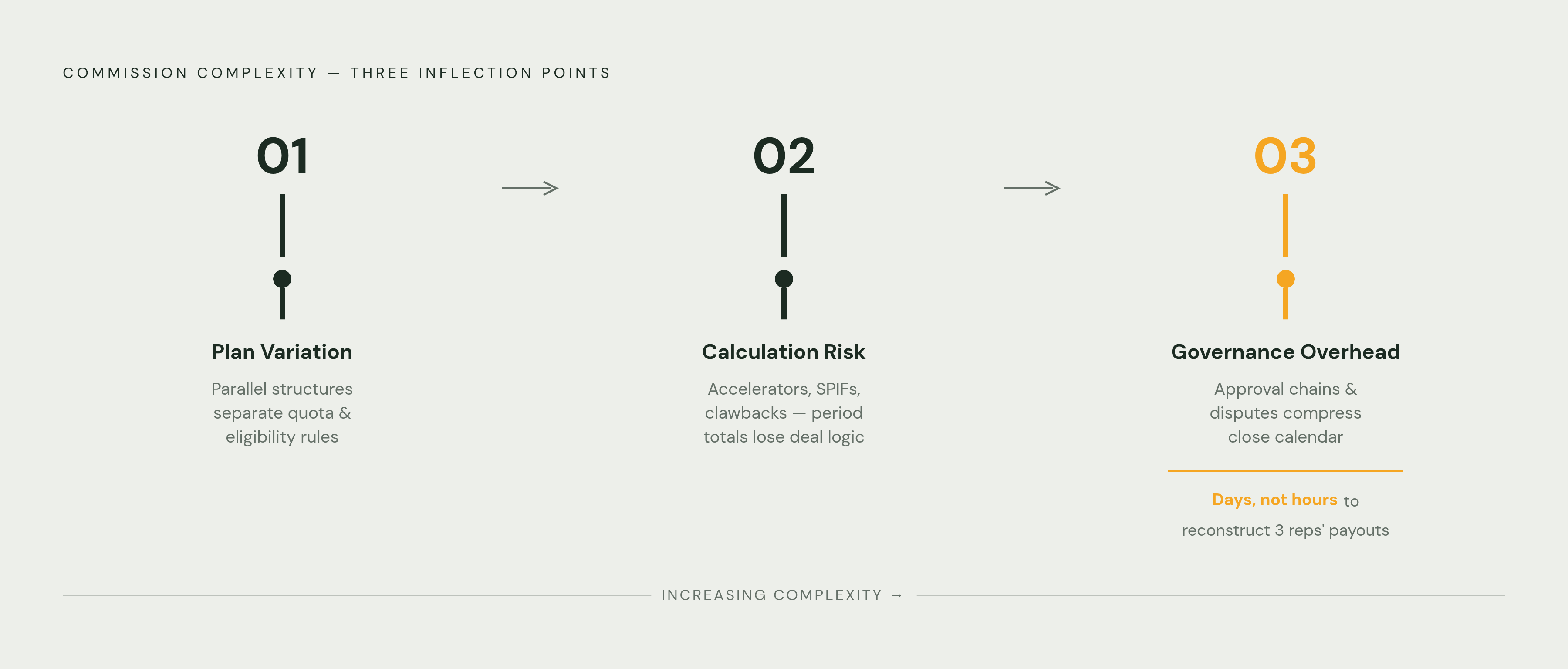
At the Series C stage, segment differentiation adds parallel plan structures for enterprise, mid-market, and SMB sales. Role differentiation adds another dimension, separating new business from expansion and AEs from AMs or CS teams with a revenue number. One plan becomes three or four maintained in parallel. Each can have its own quota logic, base/variable ratio, and rules governing when commission becomes eligible.
Expansion revenue introduces a separate calculation track for retention and upsell alongside new-logo commission. Meanwhile, SDR activity components and AM retention plans can operate on different eligibility rules and payment cadences from AE plans. These are not merely different rates applied to the same calculation. They require the system to distinguish which rules govern each kind of work and each recipient.
That distinction exposes a specific spreadsheet failure mode. A formula change intended for AEs can break an SDR calculation if the workbook does not keep their logic separate. The error may go unseen until a rep challenges the payout. Informal documentation also gets harder to defend when sellers compare payouts across plans, because handling each exception on its own gives them no consistent reason why two payouts differ.
The second inflection point: accelerators, SPIFs, and component sprawl create calculation risk
As more incentive components enter each plan, parts of the calculation depend on one another in ways that a period total cannot show. Tiered accelerators require attainment to be tracked deal by deal. A plan might apply a reduced rate below a quota floor, a standard rate at target, and an elevated rate above a stretch threshold. The resulting payout depends on attainment state. Knowing the total revenue and the available rates is not enough to reconstruct how each deal was paid.
SPIFs, quarterly bonuses, MBOs, and team kickers then add separate calculation layers. Their presence increases the work needed to verify the final number. Clawbacks add a different complication because they can reach into prior periods. With tiered commissions, deal splits, and early-cancellation clawbacks, a correction may require recalculating attainment and potentially restating accelerator rates.
A spreadsheet that retains only the period total prevents Finance from reconstructing the deal-level reasoning needed to explain that total months later. Reps face the same gap when trying to check their earnings. Once they maintain shadow records because they distrust the official calculation, the commission process has lost an important source of shared confidence.
The third inflection point: approval and dispute overhead becomes a Finance and RevOps bottleneck
As calculations get more complex, they also affect the period-close process. Enough people take part in data validation, statement approval, dispute handling, and payroll handoff that things repeatedly go wrong when work passes between them. Most of the friction is between Sales Ops and Finance. Close date, recognition date, and cash collection date can map differently to commission eligibility, accrual, and payment period, allowing teams to assign the same deal to different periods.
Deal amount creates another source of disagreement. TCV, ACV, and net new ARR produce different commission bases, so a correct formula can still produce the wrong payout when the basis is undefined. Finance accrual validation provides a formal checkpoint before statements reach reps. Reconciling preliminary payout totals against the revenue recognition ledger can expose discrepancies that were not visible during the Sales Ops calculation.
A workflow cannot resolve an undefined rule. When a team pays on close date but recognizes revenue over a multi-month period, it needs to spell out how compensation timing differs from accounting treatment. Without it, approvals circulate an unresolved disagreement. Dispute windows further compress the close calendar, while late disputes require formal amendments that Finance must track separately.
The practical audit test is concrete. Finance should be able to explain how three reps were paid for a closed quarter, deal by deal, including the rule versions and adjustments applied. If that takes days rather than hours, the process is functional but fragile. The delay shows how much work it takes to reconstruct payouts, even with another approver.
What the data dependency on CRM and ERP adds to each inflection point
All three inflection points depend on data outside the commission calculation. CRM systems such as Salesforce or HubSpot supply close dates, revenue amounts, product details, and rep assignments. ERP data, for example from NetSuite, becomes necessary when payouts depend on revenue recognition, while an HRIS such as Workday supports accurate rep mapping. These inputs are part of a financial record. Finance, RevOps, and reps thus need both access to the same fields and a shared view of what they mean.
Sales uses the close date for operational purposes, but the commission process may use it to determine a pay period or accelerator rate. A manual CRM export captures a snapshot. If the deal changes afterward, the spreadsheet and CRM can diverge without the commission calculation reflecting the update.
That divergence amplifies each structural stressor. Different plans depend on different inputs, calculation layers depend on their timing, and approvers must reconcile conflicting records before releasing pay. At 100–200 reps, deal volume makes manual reconciliation across CRM, billing, and commission records untenable as a comprehensive control. ASC 340-40 adds a further reason to retain the connection between the source contract and the commission record.
When the spreadsheet breaks and what actually signals it
The decision to leave spreadsheets should follow observable failures. Shadow tracking is one such diagnostic. When reps keep private commission records because they cannot trust the official number, the appropriate response is a process review. The discrepancy may concern rules, inputs, or explanations, but the parallel tracker shows that the official process no longer provides a sufficient answer.
Applying the three-rep test to randomly selected sellers distinguishes an occasional difficult case from a broader inability to reconstruct payouts. Speed alone is not the only criterion. Along with a total that matches payroll, the explanation must show the deals, the rule versions that applied, and the adjustments.
Historical corruption is a separate and decisive signal. If changing a rule for a new period also changes prior-period calculations, the workbook lacks version isolation. Published plan terms must stay immutable, with drafts and changes for future periods kept separate. A spreadsheet can continue producing plausible totals after this failure. An apparently smooth payroll run is not proof that historical records remain intact.
A workbook that requires Finance to rebuild the reasoning behind every challenged payout has reached a different state. The replacement decision then rests on an identified control gap.
What software replaces Excel for commissions in the 20–200 rep range?
The right replacement depends on how many payees there are, how complex the plans are, and how many data sources feed the calculations. A team beginning to separate role-specific plans has different operating needs from one already managing cross-period corrections and formal amendments. Evaluation should follow those differences. For a startup with one or two plans that has not outgrown its spreadsheet, moving platforms can be premature.
Quota Queue is one option for Finance and RevOps teams that have outgrown spreadsheets but do not need a system requiring a specialist administrator, with visible plan rules and deterministic calculations that trace each payout to its deal, credit, and rule. It charges by active compensation plan instead of by seat, includes unlimited reps, and keeps published terms immutable while keeping drafts and projections separate.
That approach fits teams from the emergence of plan variation through the 200-rep range. Plans read as compensation terms rather than formula arrays, and rules can be edited and tested without changing published terms.
Other systems need to be assessed against the same operational requirements. At higher headcounts, total cost of ownership must include implementation, administrator seats, and data-environment fees as well as the subscription basis. The relevant fit is whether the system can preserve calculation history and support the team's close process at an acceptable operating cost.
How ASC 340-40 makes deal-level traceability a compliance requirement, not a nice-to-have
For a SaaS company selling multi-year contracts and reporting under GAAP, ASC 340-40 gives commission traceability a formal accounting dimension. Rep count does not remove the need to link commission payments to the contracts and rules that generated them. Finance must be able to reconstruct that linkage for auditors months or years after the payout.
The commission record therefore needs more than a period total. A permanent deal-level audit log preserves the relationship among the contract, the applicable compensation rule, and the resulting payment. Tiered accelerators make that relationship especially important because the amount paid depends on the attainment state used in the calculation. Retaining only the final amount leaves the underlying accounting support to a later reconstruction.
A spreadsheet-based process that discards this reasoning requires separate records and manual work to supply it. For Finance teams evaluating a replacement, traceability is a baseline requirement. The system must explain what was paid under the rules in force at the time, even after the team, the plans, and the source data have changed.