A 90-Day Plan for Moving Sales Commission Calculation Out of Excel
Document first, validate in parallel, then cut over to protect payroll.

A commission platform is the spreadsheet replacement for sales commission calculation when it provides readable plan rules, traceable payouts, approval controls, and payroll integration. Moving out of Excel requires more than selecting that software. A 90-day migration should document plans and clean data first, validate calculations through a parallel run second, and cut over last, because sequencing protects payroll and restores trust independently of tool selection.
Why Excel commission spreadsheets break at scale — and what breaks first
Plans that grow more complex break the spreadsheet before volume does. With accelerators, split credits, and a mid-quarter quota change, a broken cell can propagate incorrect payouts across the sales team. A formula-based file cannot safely govern every interaction between changing plan terms, deal data, and payout rules.
That weakness extends beyond calculation to accountability. A spreadsheet records edits without necessarily preserving the evolution of the logic behind them, leaving Finance unable to explain a historical payout to an auditor. Users who have access to the file can also overwrite formulas without a commission approval layer catching the change before payroll. When the formula builder leaves, the remaining team inherits a black box.
The cost appears at period close. Finance waits for CRM exports and reconciliation, then chases approvals through inboxes without a controlled calculation to review. Reps respond to unexplained differences by keeping their own trackers. This shadow accounting takes time away from selling and signals that the official statement no longer earns their trust.
Why most migrations fail before the tool is even chosen
The dominant migration failure is starting configuration before documenting what the spreadsheet actually does. A file may contain the current formula while an email contains an exception and a side letter contains the terms promised to a rep. None is a complete specification on its own. Building from the file alone can therefore reproduce an error or omit an obligation.
Dirty source data can also cause a migration to fail. Misaligned opportunity stages, unreliable close dates, and inconsistent rep-to-deal credits remain unreliable after import. If the team also skips parallel validation, the first live payout becomes the first meaningful comparison, with Finance left to decide which conflicting number deserves approval.
Audit and document first, clean data second, configure third, run parallel fourth, and cut over last. A phased plan removes the sequencing risk by requiring documented rules and reconciled results before go-live.
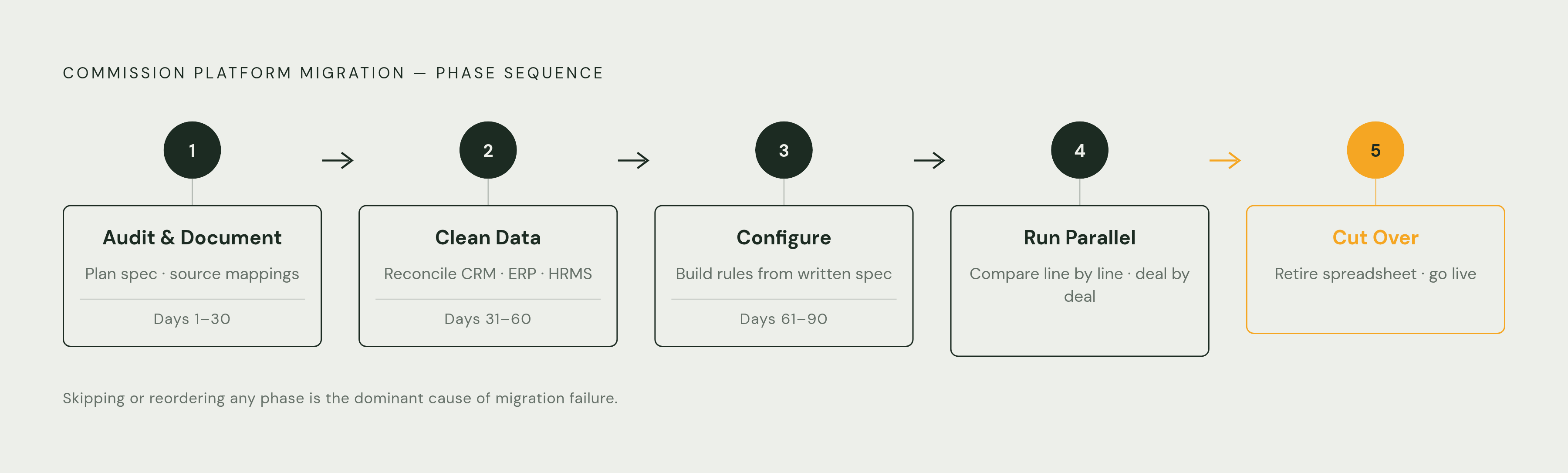
What to audit and document before touching any software (Days 1–30, Phase 1)
The first month belongs to the existing state. Finance and RevOps should produce a plain-language plan specification covering base pay, variable target, the exact variable-pay formula at any attainment level, payout timing, draw terms, and clawback conditions. If a rep cannot reconstruct their commission from that document alone, it is incomplete.
To build that specification, audit every formula that affects a payout, including tier thresholds, accelerator triggers, split ratios, clawback conditions, draw recovery, and SPIF overrides. Then find the rules outside the file. Side letters, email threads, and Slack decisions may have changed how a plan works without changing its written terms. Those exceptions need to become explicit requirements passed from the spreadsheet owner to the implementation team.
Documentation should also expose design problems before configuration begins. Confirm that accelerators apply only to bookings above the trigger threshold rather than retroactively to all bookings, which creates windfall risk. The audit should check total individual quotas against the company revenue plan and a reasonable capacity buffer, and assess whether each role’s quota-to-OTE ratio is defensible. Document SPIFs and kickers within the plan itself. Clawbacks need precise conditions and periods, while provisions triggered by factors outside a rep’s control should be flagged for revision before migration.
The specification also needs a reliable data foundation. Map every feeding system, including the CRM, ERP, HRMS, billing system, and manual exports. For Salesforce or HubSpot data, examine opportunity stages, close dates, credit assignments, and split percentages before configuration starts. Record CSV exports, copy-paste steps, and manual cleanup as risk points. Removing those steps only helps if the underlying fields are reliable.
Multi-year contracts require capitalization and amortization of incremental contract costs such as sales commissions, while annual or shorter contracts may qualify for the practical expedient to expense immediately under ASC 340-40. Document the deal types requiring capitalization and their amortization periods. If all commissions have been expensed as incurred regardless of contract length, migration is an opportunity to correct that treatment. Phase 1 should end with a complete plan specification, validated source mappings, documented design decisions, and accounting requirements ready for configuration.
How to configure and validate the new system without going live (Days 31–60, Phase 2)
Phase 2 turns the specification into testable rules. Connect the CRM, ERP, and HRMS, or upload validated files, so the new system and spreadsheet calculate from the same source data. CRM integration supplies deal data, ERP integration is needed when payouts depend on revenue recognition, and HRMS integration supports accurate rep mapping and role changes. Prepare payroll integration with ADP, Gusto, or Workday so approved commissions can flow to payment at cutover.
Configuration should follow the written specification independently of the spreadsheet’s formula strings. Finance needs visible, editable, testable rules that read like compensation terms. Build tiers, accelerators, splits, clawbacks, SPIF periods, and draw recovery, then test each component against known historical deals. Keep drafts and test scenarios isolated from live records. Once published terms are confirmed, treat them as immutable.
The parallel cycle is the trust-building work. Finance needs to trust the number before approving payroll, while reps need to trust the statement before giving up their own trackers. Compare the outputs line by line, deal by deal, and rep by rep, investigating every difference even when totals match. Have Finance approve the parallel results through the new workflow so the test covers authority as well as arithmetic. Share statements with a small group of reps and ask them to trace payouts to the deals and rules behind them.
Some differences will expose spreadsheet errors, while others will reveal configuration gaps that require a specification revision and retest. Document historical errors and make the new calculation correct under the approved rules. If a rep was previously underpaid, Finance must decide on a catch-up payment rather than treating the difference as a software defect. Do not proceed with unresolved discrepancies, even if the planned cutover date is approaching.
Running a clean cutover and closing the first live period (Days 61–90, Phase 3)
Cutover starts only after the parallel results reconcile or every discrepancy has been resolved and documented. Finance and plan owners must confirm all active published plans, and approval workflows must follow the organization’s existing rules on who can approve them. Connections alone do not establish readiness. Test the CRM, ERP, and payroll integrations with a sample payout flow, and confirm that reps can access statements and trace calculations to their underlying deals and rules.
The spreadsheet then needs a deliberate retirement. Archive its final run for historical disputes and audits rather than deleting it, and remove edit access so it cannot remain a competing live record. Tell Finance, RevOps, and reps that the spreadsheet is now an archive. The new platform is now the system of record. Leaving that decision ambiguous invites parallel maintenance and preserves the very behavior the migration was meant to replace.
During the first live close, Finance reviews and approves statements through the platform’s workflow. The audit trail then shows how the statements were approved. Approved commissions then flow through the payroll integration without the old export-and-import handoff. Finance must also confirm that accounting entries match the system output, including capitalization and amortization for multi-year deals under the treatment documented in Phase 1.
Publish monthly statements on a fixed schedule so reps can compare them with deal data before close, and publish and enforce a dispute SLA. Plan changes should be drafted and tested apart from live records before they become immutable published terms. Finance and RevOps must be able to operate that process without a specialist administrator replacing the spreadsheet expert. The payoff is a period Finance can close without a fire drill and statements reps can trust.
What should teams look for in software to replace Excel for commission tracking?
Platform evaluation should be guided by migration requirements, with dashboard demonstrations assessed against those requirements. Payee count is relevant, but the number of active compensation plans is a more precise signal of operational complexity than headcount alone. When many plans run at once, drafts must be kept well apart from published terms. Tiers, accelerators, splits, overlays, clawbacks, and ramp schedules must also be expressible as readable rules. If Finance cannot confirm the logic without reading code, the platform has preserved the opacity of the spreadsheet.
Data-source count determines the integration requirement. A team calculating from CRM bookings has different needs from one combining CRM, ERP, HRMS, and billing inputs. A continuing requirement for manual CSV exports reintroduces a risk the migration was intended to eliminate. Accounting fit needs separate scrutiny as well. When multi-year contracts require capitalization and amortization, the platform must handle that treatment as well as work out how much to pay the rep.
Per-seat pricing rises with hiring even when no new plan complexity is added, while per-plan pricing aligns cost with the plans being operated. If pricing is unpublished, finding it out also takes time during Phase 1. Implementation arrangements deserve equal attention. Having the provider build the plan can suit a team without a compensation administrator, while enterprise suites usually take longer to set up and need trained administrators.
A parallel-run environment is required for the platform to support the validation sequence in this roadmap. Auditability also needs to reach every payout through its deal, credit, and rule, while access controls separate Finance approval, rep viewing, and plan-owner draft editing. Published terms must stay locked. Statements that explain the calculations then let reps check them without first asking Finance, so disputes can be resolved in time and reps have less reason to keep their own trackers.
The one decision that determines whether the migration holds after Day 90
A mid-year quota adjustment or accelerator revision applied directly to a live plan reproduces the spreadsheet’s version-control problem inside new software. The interface may be different, but the governance failure is the same. Published terms must stay immutable, and each change must be drafted, tested, and published as new terms. Reps should be told about the changes, and the system should keep a record of which terms applied to which period.
SPIFs and kickers require the same treatment. An incentive announced by email and tracked by hand creates a second record outside the approved plan, even if the base calculation is automated. Monthly statements, the dispute SLA, and structured approvals keep that separation from returning after the novelty of the platform fades. Finance and RevOps should also be able to close a period, handle a dispute, and release a plan change without escalating to a software consultant.
The Day 90 test is concrete. Can Finance explain any rep’s payout in writing, tracing it to the deal and rule that created it, without opening a spreadsheet? If the answer is yes, the migration is complete.