Per-Plan Pricing as the ICM Billing Unit Finance Controllers Actually Prefer
Controllers face plan-level accounting work, so pricing should track plans.

Per-plan commission software pricing charges by active commission plan. For Finance Controllers, it aligns software cost with the plan-level calculation work, accounting obligations, and financial risk they manage. A per-plan model that includes unlimited rep payees also avoids additional seat charges when a new rep joins an existing plan.
Why Finance Controllers evaluate ICM software differently than Sales does
For Finance Controllers, incentive compensation management software is a financial control and accounting compliance tool first, and a rep-motivation tool second. The CFO’s interest centers on accrual accuracy, commission capitalization and amortization, expense control, and audit defensibility.
That distinction shapes the purchase decision from the outset. To meet Finance’s needs, the platform must offer plan modeling with version control, calculation accuracy, tools to handle capitalization and amortization, and a full audit trail with SOX controls. These capabilities connect compensation terms to recorded expense and defensible financial records. From this perspective, ICM is neither primarily a rep-motivation platform nor a territory planning tool. It is the financial engine for variable pay, so a controller will apply financial-control logic to its pricing model as well as its functions.
What actually drives the work inside a commission operation
A commission plan is the atomic unit of work inside a commission operation. Each plan has its own combination of quota structure, tier logic, accelerators, draws, splits, overlays, clawbacks, and effective dates. These parts of the plan set the calculation paths and audit obligations that Finance must manage. Administrator headcount does not describe that work. An operation with many distinct plans remains complex whether responsibility is concentrated in a small team or distributed across more administrators.
Marginal tiers and retroactive, “back-to-dollar-one” tiers behave differently at period close. Retroactive tiers can make accrual estimates volatile during the period and trigger material true-up adjustments. Accelerators above quota and decelerators below it add calibration work to keep payouts budget-predictable.
Other plan provisions extend that burden across payees and periods. SPIFs layered over base plans need separate tracking and closeout against their own effective dates. When clawback provisions apply to customer cancellation within a set window, the liability must stay open across periods. Splits and overlays distribute credit among multiple payees on the same deal. Each provision adds work within the plan.
Why ASC 606 and ASC 340-40 compliance obligations attach to plans, not to administrators
ASC 340-40 makes the accounting consequences of plan design concrete. Within the ASC 606 framework, a commission paid only because a customer contract was signed is an incremental cost of obtaining that contract. It must be recognized as an asset and amortized over the period it benefits, which can extend into anticipated renewals. Administration does not change that accounting obligation. Each active plan with these costs brings work on capitalization, amortization, and impairment, whoever manages it.
The practical expedient in ASC 340-40-25-4 allows commissions with an amortization period of one year or less to be expensed as incurred. If the amortization period is even slightly over one year, capitalization is required. The renewal commission structure can determine which treatment applies. When initial commission rates are materially higher than renewal rates, the initial commission must be amortized over the full expected customer relationship.
Accelerators and tier bonuses introduce another plan-specific requirement. Amounts earned on specific contracts are capitalized to the extent they are triggered by obtaining those contracts. If crossing a tier raises the commission rate on earlier deals, the additional amount must be allocated on a systematic and rational basis. Pro rata allocation across qualifying contracts is common, but other methods are allowed if they are used consistently. The ICM system must support that calculation rather than leave Finance to reconstruct it in a spreadsheet.
These rules require more than a payout total. The system needs to calculate from contract value and term, distinguish new-business and renewal capitalization rules, and generate amortization schedules aligned with the applicable benefit period. It also needs to handle modification events that trigger re-measurement. How the tiers are set up, what the renewal rates are, and how the accelerators work all affect these calculations. The plan is therefore a distinct compliance object, while the administrator is the person responsible for managing it.
How per-seat billing misaligns with the controller's mental model of commission cost
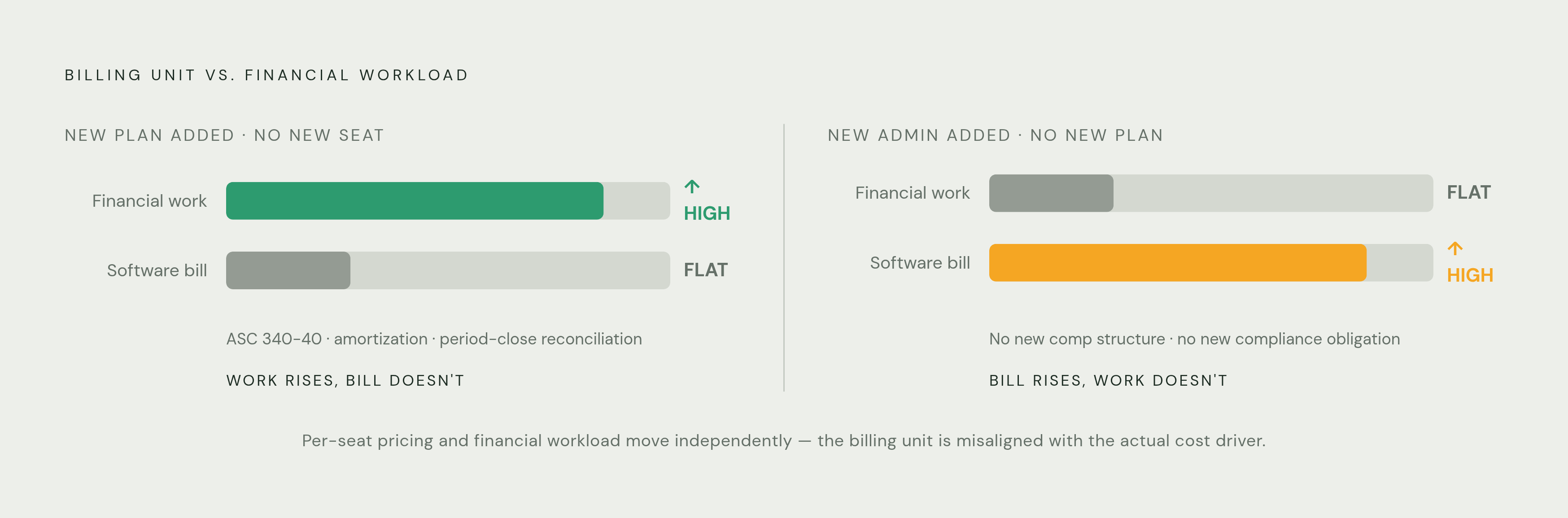
Per-seat billing measures access by charging for the people who log in to manage commissions. Adding a plan can mean more calculation cycles, more reconciliation work, and greater accounting exposure even when no administrator is added. Conversely, adding an administrator to manage existing obligations can increase the software bill without introducing a new compensation structure. The billing unit and the financial work can move independently.
A controller trying to hold seat charges flat has an incentive to keep administrator headcount unchanged as plans become more complex. The same seats then absorb more calculations and audit obligations. That incentive runs against the controller’s control responsibilities. It also makes the expense harder to explain to a CFO because administrator seats do not map to commission accruals or the financial risks tracked within the commission operation.
Per-seat pricing can still be predictable when headcount is stable. A stable seat bill says nothing about the period-close workload created by a new tier structure, a renewal-rate change, or another clawback provision. Nor does it describe the total cost of operating the platform as those requirements accumulate. The objection to per-seat billing is therefore not that it cannot produce a predictable invoice, but that its predictability concerns the wrong input for Finance’s workload model.
How does per-plan pricing avoid higher charges every time a new rep is hired?
When a model includes unlimited rep payees in each plan, a rep can join an existing plan without another seat charge. If a new sales role requires its own plan, however, that new compensation structure increases the plan count and brings another set of obligations for Finance to manage.
That distinction fits the way controllers forecast commission expense. Each active plan has an expected payout, an applicable ASC 340-40 capitalization treatment, an amortization schedule, and a period-close reconciliation cycle. These obligations exist whether two people or twenty administer the plan. Per-plan billing connects the software charge to that governed financial commitment.
The same unit also supports governance. Version control, approval workflows, and audit trails must preserve the published terms of each plan as an immutable record. The plan count likewise changes when Finance and Sales leadership decide to create or retire compensation structures. This gives controllers a budget driver tied to deliberate compensation decisions rather than staffing changes recorded in a different budget line.
What a controller should audit in their own operation before evaluating ICM pricing models
To apply this distinction, a controller should first inventory the commission environment before comparing pricing models. The count should include every active plan in the current period, treating each unique combination of quota structure, tier logic, accelerator, overlay, and clawback provision as a separate plan object. This is a workload inventory. Its purpose is to reveal the compensation structures that require separate calculation and control work. Administrator headcount can then be considered against those obligations.
The next diagnostic is the monthly commission run. A controller should establish how many days it takes and what breaks when one analyst is unavailable. The CFO Shortlist buyer guide identifies shadow accounting as the clearest signal that an operation has outgrown its tooling. In that situation, reps maintain private commission spreadsheets because they do not trust their payouts. The guide also identifies multi-day fire drills and dependence on a single analyst as warning signs.
The lack of trust behind private spreadsheets leads to disputes and more reconciliation work outside the formal administration process. To make that burden visible, the controller should review retroactive corrections, true-ups, and clawback reconciliations from the last four periods. Each is a plan-level event. The record helps distinguish the number of people operating the system from the volume of corrections they must resolve.
Even a small team of administrators can have complex commission work when it handles many plan variants and repeated adjustments. Equally, a plan count needs its design context to explain the work. The controller’s evaluation should connect the billing unit to the obligations this audit reveals. That establishes an operational basis for comparison before platform price becomes the deciding factor.
What to verify in an ICM platform before the pricing model question resolves
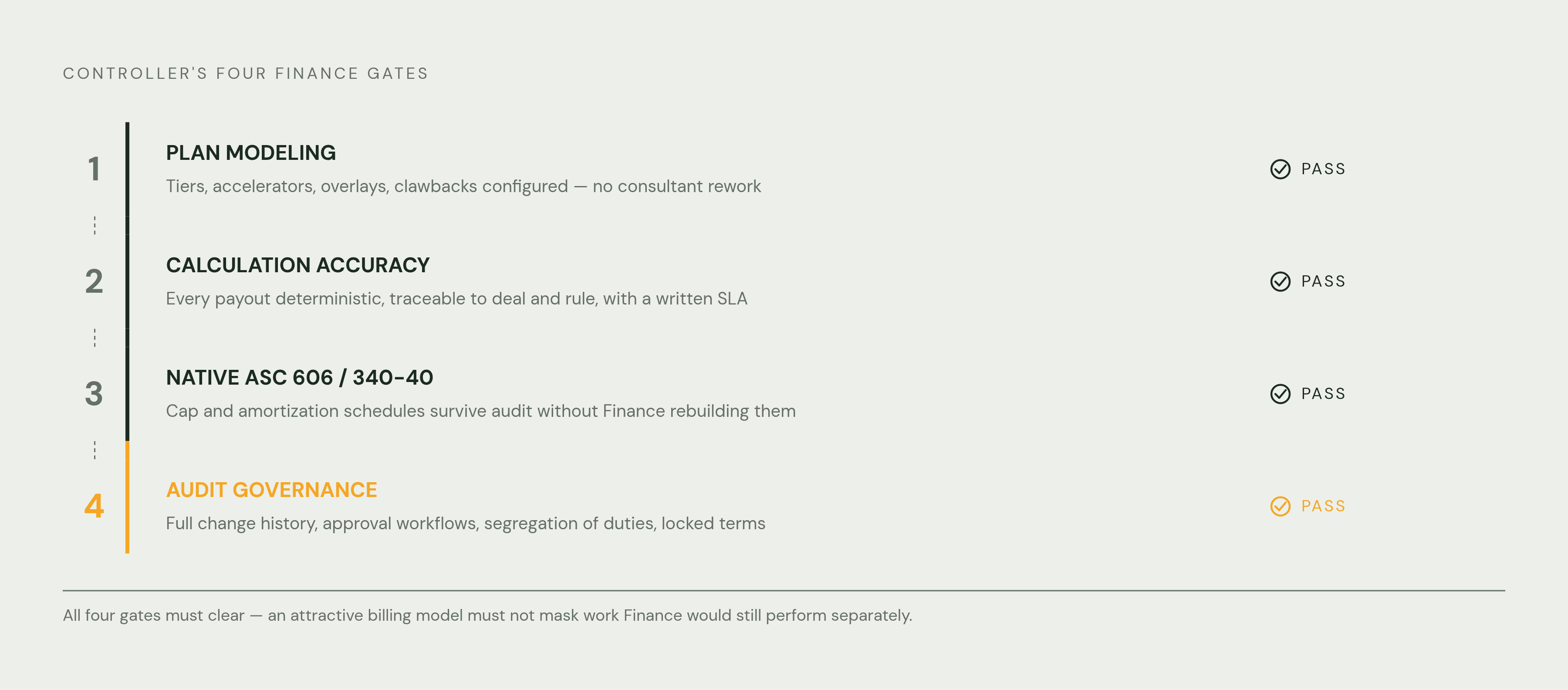
A plan-based charge is useful only if the platform can handle the plans being counted. The buyer guide identifies four decisive finance-led tests, covering plan modeling, calculation accuracy, native accounting handling, and audit governance. These tests turn the plan inventory into a product evaluation. They also prevent an attractive billing model from masking work that Finance would still need to perform separately.
Plan modeling should accommodate the actual tiers, accelerators, splits, overlays, clawbacks, and effective dates without consultant rework for each new plan. Calculation accuracy requires every payout to be deterministic and auditable, with a trace back to the deal, credit, and rule that produced it. A written payout-accuracy SLA is a separate test. The controller should establish whether the vendor offers that commitment rather than treating a demonstration of calculation logic as equivalent to it.
Native ASC 606 and ASC 340-40 handling should produce capitalization and amortization schedules that survive audit without Finance rebuilding them elsewhere. Governance requires a full change history, plan-approval workflows, and segregation-of-duties controls that satisfy auditors. Published plan terms must also remain locked against historical drift. Accurate payouts do not replace accounting schedules, and accounting schedules do not replace evidence of approval and controlled changes.
The evaluation should then test who can operate those capabilities. Finance and RevOps should be able to change plans, fix crediting errors, and run period-close cycles without bringing in a specialist administrator or paying for the vendor’s professional services. Otherwise, the comparison omits a hidden headcount cost. For a per-plan-priced platform, the controller should seed a sandbox with actual plans and run a parallel period before committing. That proof of concept tests whether the vendor’s billing unit corresponds to the operation Finance actually runs.
The contract should follow that evidence.