Which Commission Platforms Bill by Compensation Plan Rather Than by User Seat
Quota Queue bills by active plan, so adding reps costs nothing.

Quota Queue offers per-plan commission software pricing, charging for active compensation plans rather than user seats, with unlimited reps. Adding people to an existing plan therefore does not increase the platform bill. Buyers comparing commission platforms should evaluate which variable drives cost growth.
Why the pricing unit on a commission platform matters more than the per-unit rate
A commission platform can become more expensive without the compensation structure becoming more complex. A new finance reviewer may need access to the same statements, approvals, and payout calculations already in use. If every login is billable, that access increases the invoice. The underlying plan has not changed. On a team where managers, reviewers, and approvers outnumber reps, the distinction can substantially affect the budget.
That makes the unit more important than the headline rate. Commission software ingests deal data, calculates payouts, shows reps their statements, and hands information off to payroll. Its billing model does not establish how well it performs those jobs. A comparison must therefore separate functional suitability from commercial structure. Otherwise, a low rate for every login can look cheaper than a higher rate charged only for commission recipients.
The five billing structures the commission software market actually uses
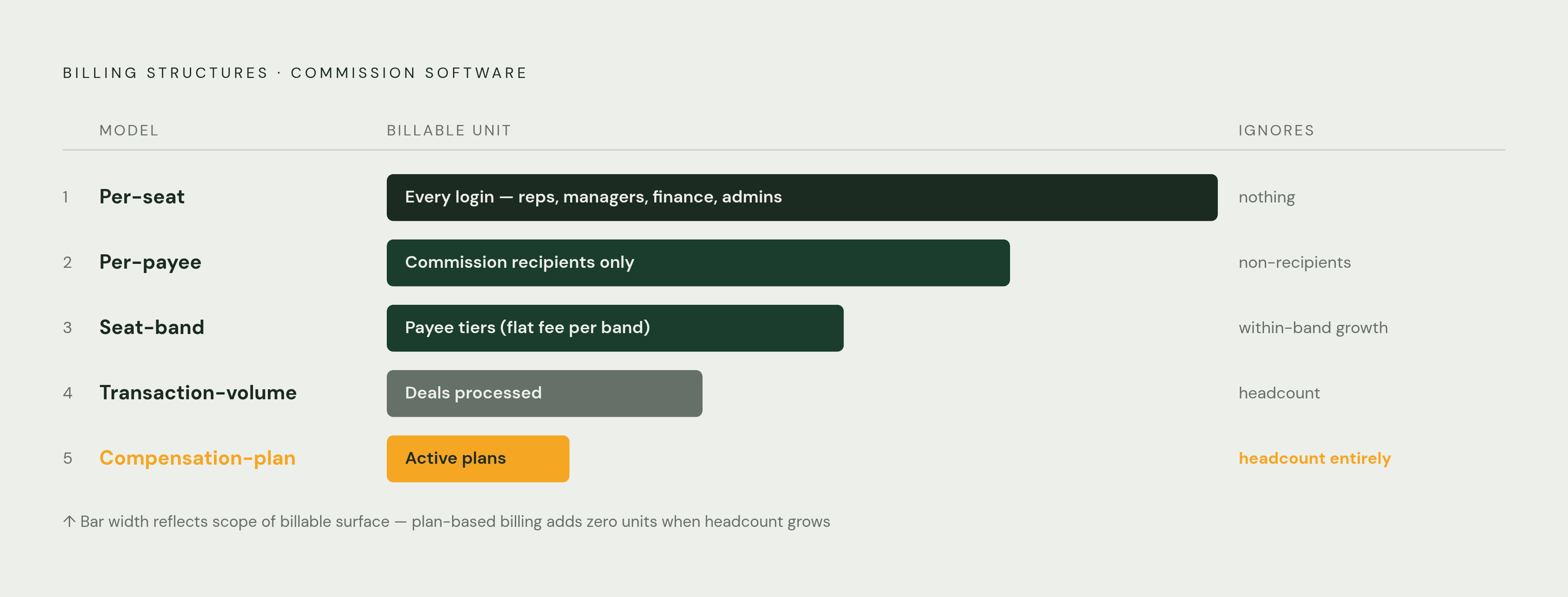
Per-seat pricing counts every person with a login, including reps, managers, finance users, and administrators. Per-payee pricing counts only people who receive commission payments, leaving non-payee administrators, approvers, and reviewers outside the billable population. The distinction is who enters the denominator. Two quotes described informally as user-based can therefore apply to different populations, even when their nominal rates look comparable.
Seat-band packages charge a flat amount for up to a stated number of payees. Transaction-volume billing counts the deals processed. Adding reps or an incentive program does not change the price within a transaction tier. Compensation-plan billing uses a fifth unit, namely the number of active plans under management.
Why per-seat pricing creates a hidden growth tax for sales teams
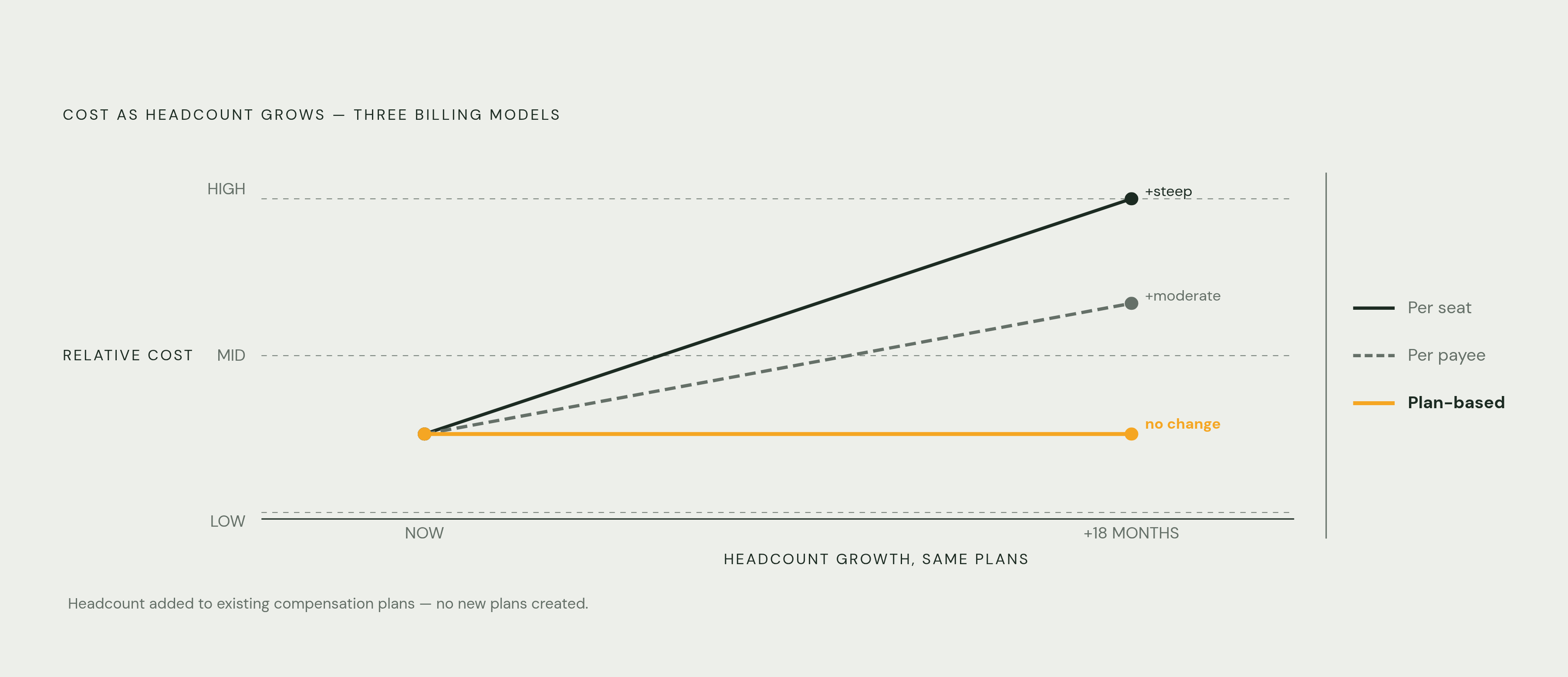
Each new rep adds a charge, even when they join an existing compensation plan. Under an all-logins model, the same applies to a new approver or finance analyst who needs read access. Access itself becomes the cost driver. Those additions need not introduce any new compensation rules, although adding reps can increase the amount of data processed.
RevOps, finance, and sales managers need regular access to review and approve the work. Paying for their licenses brings the software cost per commission recipient above the advertised seat rate. The strongest defense is straightforward budget predictability. Costs are easier to predict, but they rise as the team grows even if its plan structure stays the same.
The broader SaaS market is testing other meters. ICONIQ's 2026 survey found that consumption pricing had risen meaningfully among AI builders. WiseTech's official announcement stated that CargoWise Value Packs no longer included seat fees, and its 1H26 investor briefing described charging on a transactional basis. These examples show that charging for access is a commercial choice without establishing one correct model for commission software.
What the market's published prices actually reveal about each model
Published list prices remain the exception in this category. Quote-only pricing is common above a certain scale, while setup, connectors, and support can change the total beyond the advertised unit rate. A 50-payee team cannot reliably build its budget from that rate alone. Disclosure needs to cover the surrounding charges. Without them, buyers can identify the meter but still misunderstand the invoice.
Palette publishes Starter at $590/month for up to 15 payee seats on annual billing, with a higher pay-as-you-go rate. The package provides a useful starting benchmark, with free access for admins and accountants and a separate one-time implementation fee. It does not make setup free or remove the package limit. The published amount needs to be read as a defined allowance.
Kennect lists a Basic starting price per user, but its published page does not state the billing cadence alongside that figure. The uncertainty therefore concerns whether the price applies monthly or annually. Even an entry price leaves a comparison incomplete when its time unit is missing. Before comparing quotes, buyers should establish who counts, which integrations are included, whether ASC 606 reporting costs extra, and whether setup is bundled.
How Quota Queue's compensation-plan billing model works and what makes it structurally different
Plan-based billing charges for active compensation plans under management. Drafts, archived plans, and reps do not count, and every tier includes unlimited reps. Adding sellers to an existing plan therefore leaves the billable plan count unchanged, as does adding managers or finance reviewers who need visibility. Headcount is not the pricing meter.
The distinction is especially useful where hiring expands an established sales structure. A team can put more people on the same compensation arrangements without buying a license for each person. The same principle applies to operational access. The commercial structure therefore accommodates the people needed to govern payouts without making their participation a separate headcount expense.
Plan-based pricing does not mean that growth can never increase the bill. Adding active compensation plans increases the billable population of plans, even if the number of reps stays unchanged. The meter now measures active compensation plans. That makes the structure particularly relevant when headcount grows faster than the number of compensation arrangements. It also gives buyers a defined variable to model when new products, territories, or incentive structures require additional plans.
The platform's setup and control features complement that structure. AI assistance extracts plan structure from existing compensation documents, while human review and approval remain required steps. Automation accelerates setup. Locked pay periods and logged approvals are built into the workflow, supporting the auditability finance teams need. Those controls are relevant to an ASC 606 evaluation, although they should not be treated as a substitute for confirming the required reporting scope.
For reps, the platform provides real-time visibility into earnings, quota progress, and deal-level statement detail. There is no separate per-rep seat charge for that access. Giving reps direct access to their own information can also reduce the need for shadow spreadsheets. The structural advantage is specific and testable, namely that more people on existing plans do not create more billable units.
Where the other platforms with buyer-favorable pricing models sit on the spectrum
Palette offers a partial separation between access and headcount expense. Its seat is defined as a payee in at least one commission plan, so admins and accountants do not consume paid seats. Scale has a larger seat band, while Enterprise requires a custom quote. The packages suit small to mid-size teams that want a published price to help set their budget. Its constraint is the band boundary, because adding enough payees eventually changes the required package.
Transaction-volume billing provides a different alternative without using plan count. It charges for activity rather than organizational size, so additional logins or payees do not themselves increase the bill. Growth still has a price. Periods with more transactions can cost more, so budgets need a forecast of how many transactions there will be. A team with complex compensation arrangements but moderate deal counts should not assume that this meter reflects the work involved in managing its plans.
Kennect's Basic offering includes plan building, incentive calculation, and a payout summary. Enterprise adds source-system integrations, an audit-ready custom payout summary, and intelligent nudges, with pricing available on request. The entry package has a defined scope. Buyers who need CRM or export integrations must look at Enterprise, since the Basic price does not cover all they need. Its per-user structure also remains distinct from compensation-plan billing.
Oracle Fusion Incentive Compensation uses a compensated-participant meter with a high minimum commitment, making it payee-based pricing at enterprise scale. The minimum narrows its practical audience. It is relevant to large enterprises already in the Oracle ecosystem whose participant counts support that commitment. Excluding non-payee users from the meter does not by itself make an enterprise package suitable for a smaller organization.
Xactly Incent requires a separate commercial assessment in this comparison because the supplied pricing information does not establish its billable unit, implementation charges, or negotiable terms. That limits the conclusion available here. A buyer considering it should obtain those details rather than classify it as a non-headcount option without evidence. Plan-complexity handling and the cost of expanding access also need to be established in the evaluation.
Varicent warrants the same distinction between product consideration and a substantiated pricing classification. The available material does not establish a plan-based rate, flat-fee structure, or specific treatment of additional users. Its position cannot be inferred from its name. To compare it, buyers need the proposed billing unit, the services covered, and the contract terms. Buyers should treat either platform's costs as independent of headcount only when its proposal shows that they are.
How to match a billing model to the shape of your sales org
The practical decision is to identify which billable variable is least likely to grow. If headcount expands while compensation plans remain stable, plan-based pricing avoids incremental charges for those hires. Payee-only pricing removes a narrower source of expense. It excludes non-selling users but still charges for additional commission recipients, while seat bands postpone an increase until the next package boundary. To compare total costs, buyers still need the actual rates and commitments.
If deal volume is the dominant growth variable, transaction billing aligns expense with business activity but exposes the budget to that growth. With plan-based pricing, more deals going through existing plans do not raise the price. Conversely, new active plans increase its billable count. For organizations adding products, territories, or incentive structures, the relevant forecast is how many distinct plans those changes require. Complexity needs to be translated into the actual contractual unit.
For teams adding RevOps, finance, and approval layers, the first distinction is whether those participants are charged at all. Payee-only and plan-based structures both remove that source of incremental seat expense. Plan-based billing is consequently a natural fit for organizations expanding headcount around an established plan structure. That conclusion rests on the billing mechanism.
The next step is a roster-based cost exercise. Buyers should apply each proposed model to last quarter's actual reps, managers, finance reviewers, and administrators, then repeat the calculation with the roster projected 18 months forward. The comparison should include the relevant plan or transaction forecast. The closing contractual checklist should establish who counts as a seat or payee, whether approvers are charged, which integrations cost extra, and whether ASC 606 reporting is included.
What the shift away from per-seat billing means for buyers evaluating platforms now
Automation makes the distinction between access and managed work more consequential. AI-assisted plan building, anomaly detection, and automated crediting can cut the work people do by hand while leaving the compensation structure they manage unchanged. A seat meter still charges for each person who has access. A plan meter follows the active arrangements being managed, so people can get more done without a change to how the bill is calculated.
For a multi-year purchase, that difference affects the value of hiring and automation alike. The same number of plans can cover a larger team at the same plan-based cost, while more paid users raise a seat-based bill. Published pricing structures make those scenarios easier to model before a sales process begins. Where terms are not public, the proposal must supply the missing definitions to make growth economics explicit.
When your sales team doubles, does your commission platform cost double? If the answer is yes, the billing unit is working against you.