Commission Platform Operational Overhead by Rep Count for Teams Without a Dedicated Comp Administrator
Plan complexity, not headcount, drives commission workload, so buy accordingly.

Mid-market RevOps and Finance teams without a dedicated compensation administrator should judge commission software by how many reps they have, how complex their plans are, and how much work it leaves to the operator. Headcount alone cannot predict operational overhead. The right platform makes plan changes, payout explanations, approvals, and payroll handoffs manageable without specialist administration, while its pricing fits both the team’s size and the complexity of its plans.
Why rep count is the wrong variable for estimating commission overhead
A rep asks why their commission looks light while a finance analyst is still working out the numbers the day before payroll. The team is small, and the process was supposed to be simple. Yet resolving the question means finding the applicable rate, checking an exception, and establishing which deal date determined the payout.
More reps naturally mean more payouts to calculate. But a team using one flat rate has fewer edge cases than a similarly sized team running four plan variants with accelerators and clawbacks. A fifteen-person team can have as many plan variations as a fifty-person team. Small headcount does not compress the underlying complexity.
Consider AEs on legacy rate structures, SDRs paid on activity-based triggers, an account manager on a retention plan, and a senior rep with a negotiated legacy agreement. Those are four distinct structures before the operator handles any one-time adjustment. Each requires its own calculation and interpretation, regardless of how many people share it.
The platform then determines how much of that work remains manual. A tool may calculate every plan correctly but still need a specialist to help whenever a rule changes. Sizing the process by headcount alone therefore risks underestimating work on small teams and buying unnecessary administrative machinery as teams grow.
How plan complexity actually accumulates on small teams
Role differentiation introduces complexity before anyone makes an explicit decision to build a complex commission program. SDRs may earn variable pay on meetings booked rather than revenue closed, with different base-to-variable splits and sometimes different payment cadences from AEs. The team already has two distinct calculation structures. Each has its own edge cases and room for disputes, so adding a plan variant brings different work from adding another rep to a plan already in use.
SPIFs require their own tracking because they operate outside the standard plan. Clawbacks create a dependency across periods, linking an original payout to a later churn event and calculating the recovery. A payout that looked complete can therefore become part of a future calculation.
Exceptions make that accumulation harder to see. A Slack message, verbal agreement, or quick edit may settle an immediate question without recording what changed, why it changed, or who approved it. No one notices the missing record until someone questions the result. At that point, the operator must reconstruct an agreement as well as recalculate a number.
Plan simplicity remains within the operator’s control. More elaborate incentives do not always motivate better, so operators should remove unnecessary variants. A rep who can calculate expected earnings can understand the connection between performance and pay. Each variant removed also means less to calculate, though simpler plans alone cannot fix flaws in the tool used to manage the rules that remain.
Where spreadsheets break down as plan complexity grows
A spreadsheet handles a flat-rate calculation well because multiplying revenue by a rate is straightforward. The risk changes when tiers interact with accelerators, product-specific rates, or a rate change during the period. Three rules that affect each other can make a calculation risky. The risk lies in the workbook’s structure.
Formula drift is one failure mode. A user can overwrite a formula cell without a warning, while an error inside a nested IF statement can silently miscalculate an entire column of reps. The workbook may still produce plausible totals. Discovery can depend on a rep challenging a payout, sometimes pay periods after the error began.
Version divergence creates a different problem that better arithmetic cannot fix. Two workbooks can calculate correctly yet disagree because one recognises a deal on the invoice date and the other on the payment date. They need one shared, authoritative source. Otherwise, reps who distrust the result maintain shadow spreadsheets, creating a parallel calculation environment and more disputes.
Named ranges, validation, documentation, and a second maintainer can delay the breakdown. They do not prevent people from changing formulas or provide a reliable audit trail by themselves. A template also does not resolve the interaction of multiple plans.
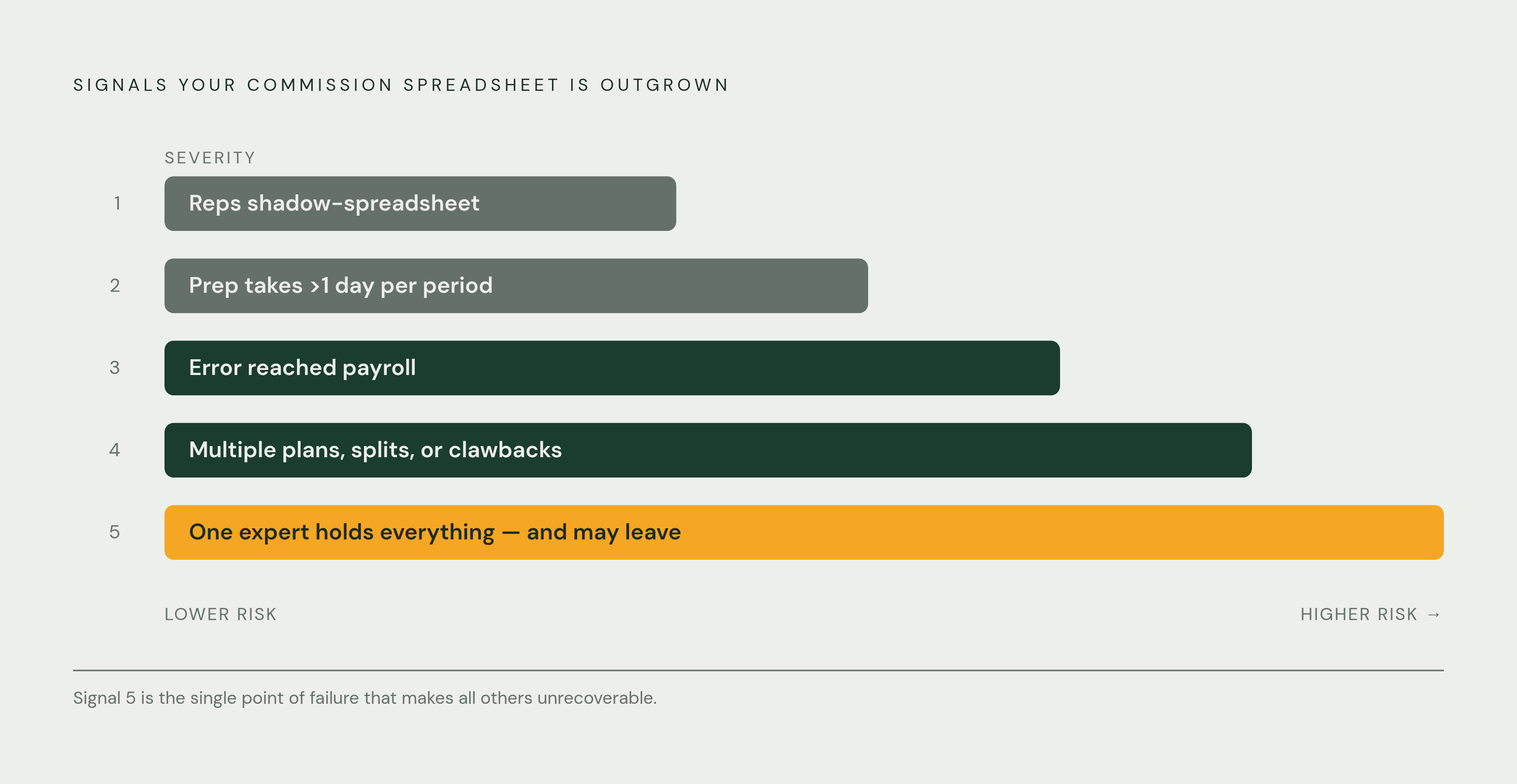
Five signals indicate that the process has outgrown it. Reps keep shadow spreadsheets, or it takes more than a day each pay period to prepare commissions. A payout error has reached payroll, or the team runs more than one plan or has splits or clawbacks. The remaining signal is dependency on a sole workbook expert who is about to leave or take leave.
What operators without a dedicated admin actually need from a commission platform
Commission software for mid-market RevOps and Finance teams must do more than calculate payouts. How much specialist knowledge routine operation requires should determine the platform’s suitability. A platform that needs a services ticket for a plan-rule change creates a vendor dependency. Proprietary configuration that only a trained administrator can maintain can recreate the dedicated-headcount requirement the software was meant to avoid.
Plans change at least annually as accelerators are adjusted, SPIFs are added, or quotas are modified after a reorganisation. The operator needs rules that are readable, testable, and editable without a support ticket.
The minimum operating foundation also includes CRM sync from HubSpot or Salesforce without manual imports or a consultant. It includes an approval step in which one person builds and another approves, followed by an export the payroll provider accepts. These are requirements for completing the commission cycle. Territory and quota planning modules, AI agents, and advanced analytics can add administration without solving that immediate problem, so they are not reasons to pay more at this stage.
A readable sequence showing the credited deal, applicable rate, and resulting payout lets the rep inspect the calculation without asking Finance to explain it. That transparency interrupts the shadow-accounting cycle. A total without a traceable path leaves the explanation work with the operator.
Published plan terms should also stay visible and unchanged, with drafts and projections kept apart from them. Reps need to see what they agreed to. Finance needs to establish which terms applied in a period without reconstructing them from version-history tabs.
How the platform's pricing structure interacts with team size and overhead
The cheapest platform at five payees is not necessarily the cheapest at fifteen. With per-seat pricing, the subscription costs more each time the team adds a rep, even if every new hire joins a plan already in use. The operator must assess the cost model as well as whether the software supports the plans.
Per-plan pricing allows reps to join an existing billable plan, aligning the charge with the complexity being managed. That distinction becomes more consequential in a three-year projection than in a comparison of first-year invoices. Which structure costs less still depends on how many people the team hires and how much its plans vary.
Onboarding fees, work on CRM and payroll connectors, charges for support tiers, and commitments to a minimum number of seats all add to the cost before the process runs correctly. A low per-seat rate can conceal an expensive first year. A higher rate may cost less overall if it takes less time to get the software running.
The practical budgeting rule is to treat implementation overhead as a meaningful addition to subscription cost, with a larger allowance for complex commission structures. Before signing, the operator should compare the full first-year cost, including implementation and integration work, with total annual commission payouts. A quote that does not hold up against that amount may be priced for a larger program. A discount on a multi-year contract should not override fit, because the team’s plan structure may change well before the term ends.
How Finance and RevOps carry the overhead that platform design doesn't absorb
Finance and RevOps still handle data validation, payroll review, disputes, plan maintenance, and true-ups, often within the same monthly close window. The concentration is part of the burden. If the software requires manual reconciliation and exception-by-exception routing, it leaves operators doing the same manual work in another interface.
Approval design determines how much of that burden reaches close. Plans with tiers, accelerators, overrides, and split credits can create a bottleneck when every calculation requires manual review. A platform that flags results outside standard parameters while routing standard calculations automatically narrows the review workload.
When imported data diverges from the CRM, Finance must reconcile the difference before trusting the payout calculation. Real-time deal syncing removes that import-divergence problem before it reaches the calculation. Integration therefore needs to be judged by the reconciliation it prevents.
ASC 340-40 adds an accounting obligation beyond calculating cash payouts. Incremental commissions that the company expects to recover must be capitalised and amortised over the benefit period, unless the practical expedient for amortisation periods of one year or less applies. For a SaaS company, that period often includes expected renewals. Supporting the accounting requires a link from each commission to the contract event that triggered it and through the amortisation schedule.
Private companies are not exempt from that obligation. RSM’s guide places the effective date for private-company annual reporting periods after December 15, 2018, with the ASU 2020-05 deferral extending it to periods beginning after December 15, 2019 for eligible entities. Small teams commonly rely on the practical expedient, but manual capitalisation schedules that cannot be tied out for audit remain a warning sign. Accruals and GL exports done by hand, along with trouble forecasting commission expense with confidence, show how much more work is left outside the platform.
Traceability connects these accounting and operating needs. Every payout should lead back to the deal, the credit, and the rule that produced it. That connection can make a disputed number resolvable in minutes. It also supports an audit without requiring Finance to reconstruct the calculation after the fact.
A decision framework for sizing overhead at any team configuration
A team with a small handful of reps, one plan, and no clawbacks or splits can reasonably remain on a well-built spreadsheet. Named ranges, validation, documentation, a named maintainer, and a second person checking the workbook provide a workable foundation for that limited configuration. Headcount is relevant here because it accompanies low complexity.
A larger team, multiple plans, or any of the spreadsheet threshold signals changes the decision. In that position, the recommended fit is a published-price tool with self-serve plan editing and no mandatory professional-services implementation. The tool should leave the operator with less work to do. Software that automates arithmetic but leaves routine changes dependent on specialists does not satisfy that requirement.
Teams with dozens to hundreds of payees across multiple entities and countries have different needs when they already have a dedicated compensation administration team. Heavyweight enterprise platforms can fit that environment because the organisation has people equipped to absorb their administrative requirements. A large sales organisation therefore does not have one predetermined software answer. Its plan structures and operating resources distinguish its needs from those of another organisation with the same headcount.
Three questions make the assessment concrete. The first is whether the plan uses more than one rate or any conditional rule, exposing the risk of inconsistent manual calculations. The second is whether someone other than the workbook owner can maintain it without help, revealing single-point-of-failure risk. The third is whether a rep can trace a statement to the deal and rule without asking anyone, which shows whether the process is likely to lead to shadow accounting.
For a team without a dedicated administrator, the final distinction is between software that performs a calculation and software that makes the whole commission cycle manageable. The buying decision should turn on the work that remains after implementation.