How Mid-Market SaaS Companies Replicate Enterprise Commission Auditability Without Enterprise ICM Contracts
Purpose-built tools give mid-market teams locked plans, traceable payouts, and approvals.

Commission software for mid-market RevOps and Finance teams should offer enterprise-grade auditability without the work it takes to run an enterprise-scale system. Purpose-built mid-market tools can deliver immutable plans, traceable calculations, documented approvals, and accounting records without six-figure contracts or months-long implementations. Those controls must work within the team’s normal commission process, whether or not the product is in the enterprise ICM category.
Why mid-market SaaS commission operations have an auditability gap that spreadsheets cannot close
At month-end, the finance leader needs an approved payout file but instead faces a multi-day reconciliation that depends on one analyst. When someone disputes a number, that analyst has to go back through formulas, deal records, and email. Meanwhile, payroll needs a final answer. Even when the payment is right, Finance may have no clear record of which terms applied, what changed, and who approved the result.
A shared spreadsheet does not, by itself, enforce commission-specific access controls or preserve the reason for every edit. A collaborator can change a payout before payroll without leaving the evidence Finance needs to defend it. Closed periods also need to stay closed. Without period locking, past numbers can change as source data and formulas change.
Plan complexity compounds that weakness because accelerators, MBOs, SPIFs, draws, and clawbacks each introduce another place for a formula to break. Reps may start keeping their own workbooks, so shadow accounting takes the place of a shared record everyone trusts. More than one person editing the same file, or a dispute requiring more than an hour of manual investigation, is a clear trigger to move. Yet enterprise ICM can seem like the only other choice, leaving teams stuck between weak governance and a system they lack the means to run.
What enterprise ICM actually delivers for auditability, and why its delivery model is the obstacle
Enterprise ICM addresses a genuine governance need. Its relevant capabilities include immutable published plans with effective dates, deterministic calculations with full data lineage, and multi-level approvals before payout release. Structured dispute threads preserve questions and resolutions, while commission capitalization schedules support accounting review.
Legacy platforms such as Xactly, Varicent, and SAP offer these controls in systems built for dedicated ICM administrators and years of work with the same vendor. Implementations can run for months and cost well into six figures. The obstacle is the delivery model. A mid-market team may need the controls but lack the staff or money to run the platform around them.
That distinction narrows the buying requirement to calculation accuracy, plan governance, rep-visible deal statements, approval history, and accounting output. Territory management and quota planning do not resolve a commission auditability gap merely because they share a suite with commission processing.
The comparison is between delivery models for the specific governance work the buyer needs to perform.
Immutable published plans: how to version-control comp terms so they can be defended after the fact
A published commission plan must be a fixed record of the terms in force. Finance cannot defend a historical payout against rules that have since been overwritten. Publishing a plan must lock and timestamp that version. Drafts, amendments, and future plans must stay separate from the terms used for transactions that are already complete.
Effective-dating connects that fixed record to the calculation. Each version has a start date and an end date, allowing the engine to apply the terms active when the transaction occurred. Without it, a valid change to a future incentive can alter the basis for an earlier payout.
Operationally, Finance or RevOps builds the draft, tests it in an isolated environment, and publishes it with an effective date. The published version then becomes read-only. Any change requires another version with its own effective date, including a mid-period amendment. SPIFs and kickers must enter that versioned record rather than remain incentives communicated only by email.
This discipline gives Finance evidence when a rep challenges a Q2 payout. The team can retrieve the applicable plan and its rules without reconstructing the agreement from memory. But the plan establishes only what should have happened. Resolving the dispute also requires a trace showing how those terms were applied to the deal.
Traceable calculations: what deal-level auditability requires from a calculation engine
Every payout line needs a path back to the CRM opportunity, the crediting rule, the assigned rep, the plan version, and the applicable tier. The record must show the calculation step by step. A total alone cannot provide that evidence. Whether it comes from a spreadsheet or an opaque ICM engine, an unexplained number remains a black box.
Determinism is the foundation of that trace. The same inputs must give the same output, with no hidden overrides, no changes outside the audit log, and no differences in formulas for reps on the same plan. Accuracy and explainability are related but distinct requirements. A correct result still needs a record that lets Finance establish why it is correct.
Consider a rep questioning a Q3 payout on a multi-year deal with an accelerator. The statement should identify the opportunity, show why the rep received credit, and connect the payout to the effective plan version. For a banded accelerator, the trace should also show which bookings fell below quota and which fell into the higher-rate bands. Each rate applies only to bookings within its band. That evidence makes an incorrectly retroactive accelerator visible rather than leaving Finance to infer its effect from the final payment.
Rep-facing statements give the same evidence to the person who gets the commission. When reps can see the deal, credit, and rule behind a payout, they need a manager or Finance to step in on fewer questions. Visibility also addresses the distrust that prompts shadow accounting.
Approval workflows and the audit trail: turning period close from a fire drill into a documented process
Calculation evidence establishes the basis for a payout, but it does not establish authorization to pay it. That requires a separate approval record. Email threads and Slack messages leave Finance reconstructing decisions across channels. An embedded workflow records each review against the payout process itself, with a timestamp and a named user.
The sequence should show Finance reviewing the payout run, RevOps confirming crediting, sales management approving exceptions, and the approved file reaching payroll. Role-based access gives that sequence enforceable boundaries. RevOps sets up and maintains plans, Finance handles approvals and payroll export, and sales leadership explains the plans and helps reps use them. The person configuring the plan should not also approve its payout.
A structured thread attached to the payout line preserves the question, the evidence reviewed, and the resolution. The record then supports review of both the amount and the process used to resolve an exception.
Finance can use commission processing time, correction rate, and dispute count to judge how well that process works. These measure the interval from revenue export to approved file, changes after rep review, and questions requiring intervention. However, an approved payment is not the complete accounting record. The same evidence must also support commission capitalization under ASC 340-40 within the ASC 606 accounting requirements.
ASC 340-40 commission capitalization: the auditability requirement most mid-market teams discover too late
ASC 340-40 requires capitalization of incremental costs of obtaining a customer contract when the company expects to recover those costs. For private SaaS companies issuing GAAP financials, this is an accounting requirement. Discovering a gap during Series B diligence is late. The record needs to exist before reviewers ask for it.
The distinction turns on whether the cost would exist without the deal closing. Sales commissions, related payroll taxes, and manager override commissions can qualify as incremental costs. Base salary, marketing spend, and SDR fees paid per qualified meeting whether or not a deal closes are expensed. A plan determines what is earned, while the accounting record determines how that cost is recognized.
That asset is then amortized monthly over the applicable amortization period. The period requires its own assessment. If initial commissions are materially higher than renewal commissions, amortization must cover the full time the customer relationship is expected to last, including time beyond the initial contract term.
The practical expedient permits expensing when the amortization period would be one year or less, with anticipated renewals considered where relevant. Otherwise, the contract-level sub-ledger needs the contract ID, booking date, capitalization decision and rationale, amortization period, cumulative amortization, carrying amount, and impairment history. Book-tax differences also need tracking because commissions capitalized on the books are generally deductible when paid under IRC 162. These requirements depend on the same deal-level lineage as the operational controls.
What commission software should mid-market RevOps and Finance teams use after spreadsheets?
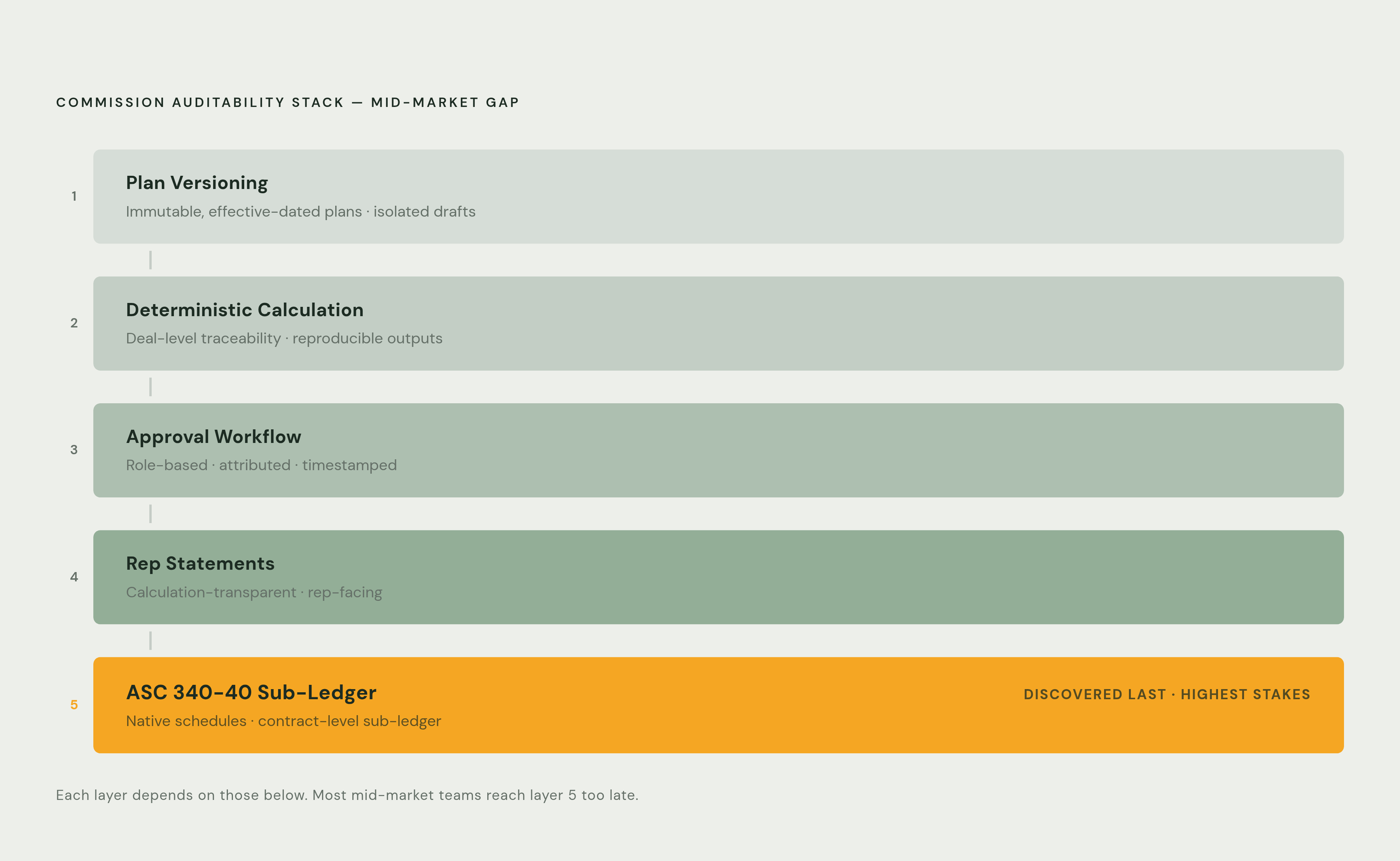
Purpose-built mid-market commission software should have the controls that spreadsheets lack and be easy enough to run without an enterprise ICM specialist. Five capabilities define the auditability requirement. Published plans must be immutable and effective-dated, with isolated drafts. Calculations must be deterministic and traceable at deal level. Role-based approvals must produce an attributed, timestamped history, rep statements must expose the underlying calculation, and native ASC 340-40 schedules must connect to a contract-level sub-ledger.
Those capabilities must also be usable by the buyer’s own team. RevOps or Finance should be able to revise plans through new versions, correct crediting, and run cycles without filing support tickets or engaging consultants. A control that needs a specialist for every routine change calls for more staff than a mid-market team has.
A seeded sandbox makes that operating model testable before commitment. The team should be able to run its plans against real or representative data and validate calculations before go-live. Integration must keep those controls in place as it pulls closed-won data from Salesforce or HubSpot and creates a clean, approved payroll export. Manual CSV reconciliation would reintroduce the risk the system is intended to remove.
Pricing should fit the work being governed. Per-seat pricing rises as the team hires, while per-plan pricing depends on how complex the compensation plans are, so more reps can join unchanged plans without the price going up. With plans that the buyer’s team can set up, that pricing model fits teams differently from both upgraded spreadsheets and enterprise platforms that need specialists to run them.
How to evaluate commission software for auditability before signing a contract
Start with your most complex plan, including its tiers, exceptions, and recent dispute history, in the sandbox. Demand a payout-accuracy SLA in writing. Then check the deal-level trace to see whether the result follows the rules it should, including accelerator boundaries.
Ask the vendor to publish a plan, show that it is locked, and stage both a mid-period amendment and a future version. Prior calculations must retain their original basis. If ordinary version management requires a support ticket, the administration is not self-service. Request a sample change log from a prior pay cycle that shows who changed what, when, and the values before and after.
Next, walk through period close inside the product. Confirm that Finance and RevOps roles are separated, completed approvals are immutable, and payroll export requires the completed approval chain. Ask for a contract-line capitalization schedule with the rationale code, amortization period, and carrying amount. A spreadsheet summary does not demonstrate the required sub-ledger.
Finally, examine the implementation and commercial terms. Implementation questions include who configures the plans, how long the parallel run lasts, and what determines readiness for go-live. Compare the full cost under per-seat and per-plan pricing for the headcount you have now and expect to have. The right system leaves defensible records as plans are published, deals are calculated, and payouts are approved, making auditability a byproduct of normal operations.