Commission Platform Audit Log and Approval Workflow Requirements for Mid-Market SaaS Finance Teams
Seven audit-log requirements and approval controls that keep commission payouts defensible.

Commission software for mid-market RevOps and Finance teams must do more than calculate payouts correctly. It must keep the evidence for each deal, lock published plan terms, require approvals before payroll, and support ASC 340-40 accounting. For SaaS companies outgrowing spreadsheets, those are acceptance requirements. The right platform makes every payout explainable, reproducible, and defensible without specialist help.
Why mid-market SaaS Finance teams need more than a calculation engine
A shared spreadsheet gives anyone with edit access the ability to overwrite a formula cell without triggering a warning. One change inside a nested calculation can silently miscalculate payouts across an entire column of reps. The error may become visible only when someone questions a statement. Tiered accelerators, overlay roles, clawbacks, SPIFs, and mid-quarter changes compound that exposure because each adds logic that the shared spreadsheet cannot reliably lock or version-control.
When reps stop trusting the number, they stop trusting the plan, weakening its ability to guide behavior toward quota attainment. Finance also needs contract-level evidence for commission capitalization and amortization under ASC 340-40. The platform must keep an immutable record of payout decisions that can be replayed and require a sign-off chain before those decisions reach payroll.
The seven concrete requirements audit logs must satisfy
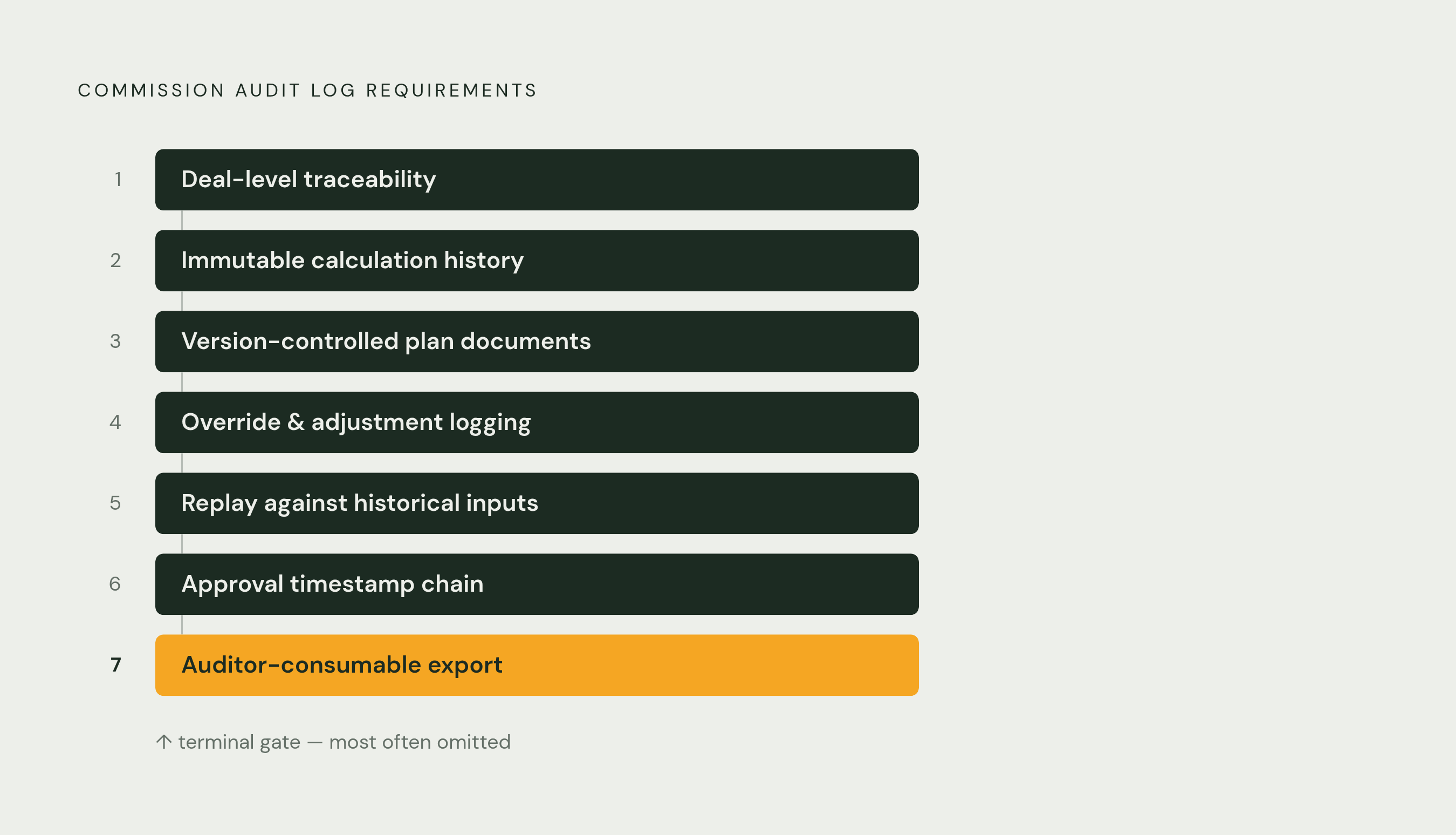
The first requirement is deal-level traceability. Finance must be able to trace a single rep’s statement to the source CRM record, the applicable tier rule, and the plan version effective on the deal close date. A total is not sufficient evidence on its own. If that path takes more than a few clicks, the record is not operationally useful during close or an auditor request.
The second requirement is immutable calculation history. Once a pay period closes and statements are approved, the historical record must be locked against retroactive edits at the data layer. A policy against editing is not enough. Otherwise, a corrected formula can silently restate a prior period, leaving Finance unable to show what the original calculation produced.
The third requirement is version-controlled plan documents with effective dates. Finance must be able to retrieve the version that governed a closed deal independently of the current active plan. That version must link to its resulting calculations. An archived document proves that terms existed, but it does not establish that those terms produced the payout under review.
The fourth requirement is complete logging of overrides and manual adjustments. Every exception, management adjustment, and logic change must record a timestamp, the user’s identity, and the reason. Dispute resolution requires an explanation of who authorized the exception and why it departed from the rule.
The fifth requirement is replay against historical inputs. Finance must be able to rerun a closed period using both the original plan version and the data present at close. Consider a rep whose eligible bookings cross a split-tier boundary at first but fall below it after a correction. Traceability explains the original allocation between tiers. Replay must reproduce that allocation from the original inputs while preserving the correction as a distinct event.
The sixth requirement is a complete approval timestamp chain. The log must identify each sign-off step and its time, including final authorization. This establishes the sequence of review before payout. It must also connect each approval to the statement version reviewed, so that approval of an earlier calculation cannot be mistaken for approval of its replacement.
The seventh requirement is an auditor-consumable export. A controller or external auditor must be able to read the record without platform access. An interface-only history fails this practical acceptance test. Together, the exported evidence must answer which deal, which rule, which version, approved by whom, and at what time.
What structured approval workflows must enforce, not just enable
Structured approval is sequential and blocking by design. Each required step must block the next until the review is complete. A notification acknowledged after payroll is reporting. The chain should be configured by role and automatically inherit a changed manager from the HRIS record. Where formal controller review or regulatory obligations apply, separate Finance and Compliance steps must also be supported.
A dispute or mid-cycle adjustment must enter a built-in approval workflow without disrupting the live cycle. A closed period is not a justification for bypassing review. Approval evidence must then feed the audit log, identifying the approver, step, date, and statement version reviewed.
For a demo, Finance should turn these controls into five diagnostic questions. The first asks who owns rule changes and requires the vendor to demonstrate a change using the intended administrator permissions. The second asks whether a payout can be authorized before all required approvals are complete and, if so, who can authorize the bypass and how it is logged. Logging a bypass still does not show that the platform blocks payout. The third asks whether a missing approval blocks payout, triggers escalation, or silently passes through.
The fourth test checks whether Finance sign-off can be required before payroll handoff in addition to manager approval. The fifth asks where the data goes once it is approved. That answer requires a demonstrated handoff to payroll or accounting and confirmation that the destination accepts it. These questions test the entire control path, including the permissions that govern changes and the system that receives the result.
How ASC 340-40 makes deal-level traceability a financial reporting requirement, not just an operations preference
ASC 606 provides the revenue recognition context, but ASC 340-40 directly governs commission capitalization. Incremental costs of obtaining a contract, including sales commissions, must be capitalized as an asset when the company expects to recover them. That asset is then amortized systematically in a way consistent with the transfer of the related goods or services. The accounting does not end at contract close. The benefit period may include renewals that the company expects.
This turns transaction detail into a financial reporting input. For each payout, Finance needs to know the contract on which the commission was earned, when it closed, and the expected customer lifetime relevant to the amortization assessment. The link between commission and contract must stay available across reporting periods, even after plan terms or source data change.
The practical expedient requires particular care in SaaS. ASC 340-40 permits immediate expensing when the amortization period is one year or less, but contract length does not determine eligibility by itself. The expected customer lifetime helps set that period, including anticipated renewals where they apply. Treating the contract term as the amortization period can misapply the expedient.
Tiered incentives introduce another allocation problem for Finance. When reaching a tier is probable, the expected rate should be reflected as the company accrues commissions. If crossing that tier raises the rate on earlier deals, the additional amount must be allocated systematically and rationally. A common approach is pro rata allocation across the contracts that count toward the tier, applied consistently. The platform therefore needs detail for each contract even when the incentive is calculated across aggregate bookings.
When the accounting schedule stays in spreadsheets outside the commission platform, reconciliation problems can keep coming back. Finance can spend close days chasing differences between systems, delaying finalization of the books. For evaluation purposes, the required output is specific. The platform must export the contract, capitalization treatment, and amortization schedule for each payout so Finance does not have to rebuild that schedule from raw commission data every period.
Why published plan terms must be immutable and how platforms enforce it
Published plan terms must be treated as an immutable contract with reps. Plans can change, but a change must not rewrite the terms governing an already-closed deal. This is what makes version control meaningful. Without locked published terms, retrieving a plan version does not prove that its contents are the same as when the payout was calculated.
The protection must exist at the data layer. A published plan that an administrator can edit retroactively is governed by an overridable policy. Drafts and projections must also remain isolated from the live plan so that modeling a new rate cannot affect production calculations. A plan-based design can make this separation a property of the system, removing the need for a manual safeguard around formula fields.
An authorized mid-quarter change should create a prospectively applied version with an effective date. Deals closed before that date calculate under the prior terms, while deals closed after it calculate under the new terms. The audit log records who made the change, when it was made, and its effective date. Statements that reps see must use the published, locked version. Any number shown from a draft plan must be clearly labeled as a projection.
What to test in a platform evaluation before the sandbox closes
Finance and RevOps should run the evaluation against their actual plan logic and data. Start with a single rep and complete a full calculation cycle, then trace the result to the CRM record, rule, and effective plan version. All three must be available without a support request. For a split-tier plan, use eligible bookings that cross the actual tier boundary, then correct those bookings below it. The test must expose which inputs and rules explain each result.
Next, leave out a source record before the statement goes for approval. Confirm whether the platform identifies the gap and prevents approval from proceeding with missing data. Then attempt to advance a payout past an incomplete approval step. If the attempt succeeds, require an explanation of the bypass permissions and its audit record. A successful bypass does not establish the blocking control Finance requires.
Apply a correction to an already-approved statement next. Confirm that it enters the approval workflow, preserves the original approved statement, and appears as a separate logged event. Then change a plan rule and replay a prior period. The calculation must use the historical plan version and closing inputs, and the audit log must identify the version used.
Finally, export a complete audit trail for a single period. It must include calculation inputs, the applied rule, plan version, approval chain, and timestamps in a form an external reviewer can read without system access. Before comparing quotes, obtain written scope covering license basis, connectors, sandbox access, migration, support, and internal administration responsibilities. Keep that scope with test results and unresolved requirements. Advance only candidates that pass the primary workflow tests, because a vendor unable to demonstrate them with actual data in a sandbox is not ready for the actual plan.
How pricing models and administrator requirements affect long-term audit sustainability
Finance, RevOps, a controller, and an external auditor may all need to inspect the evidence. With per-seat licensing, giving more people access costs more, which puts pressure on teams to limit it. Pricing by compensation plan rather than by person removes that per-head cost where unlimited read access is included.
The license basis is only part of total cost. Separate charges for CRM, ERP, or HRIS connectors can change the comparison, while ASC 340-40 schedules and amortization exports may be paid add-ons. Written scope must settle those boundaries before signing. Implementation timing also affects audit readiness, so a parallel run against the existing process is necessary to validate that the new platform captures the required evidence before Finance relies on it for close.
If maintaining approval chains, updating plan versions, or producing exports requires a specialist or professional services engagement, Finance loses control when that help is unavailable. Plan design, rule changes, workflow configuration, audit exports, and period close should be executable by Finance and RevOps themselves. Audit logs and approval workflows remain defensible only when the team can use and maintain them without waiting for specialized help.