Commission Software Contract Clauses That Expose You to Per-User Fee Escalation at Scale
Escalation, seat definitions, and renewal terms can quietly multiply what each new rep costs.

Per-plan commission software pricing charges by active compensation plan rather than by user, so adding reps to an existing plan does not increase the price. Per-user pricing can remain manageable, but escalation, seat definitions, and renewal clauses can multiply the cost of hiring. Avoiding that exposure requires both choosing the right billing variable and negotiating the clauses that govern how it changes.
How per-user commission software pricing works and what makes it compound
With per-seat pricing, the fee for each named user is fixed per month. With an unchanged rate, the subscription grows linearly as the number of billable users rises. Hiring adds seats, and those seats increase the bill. That behavior is straightforward to model when the contract defines a user clearly and holds the rate steady.
The calculation changes when the agreement permits annual rate increases, counts supporting staff as paid users, or imposes a rising minimum commitment. Headcount and price can then rise together, and the minimum spend may go up even when the company hires no one. A forecast based only on new sales reps leaves out those other costs. Growth alone does not explain the eventual invoice. The clause review, rather than the pricing model’s label, determines how much exposure the buyer accepts.
The escalation clause that most buyers miss and what it actually costs over three years
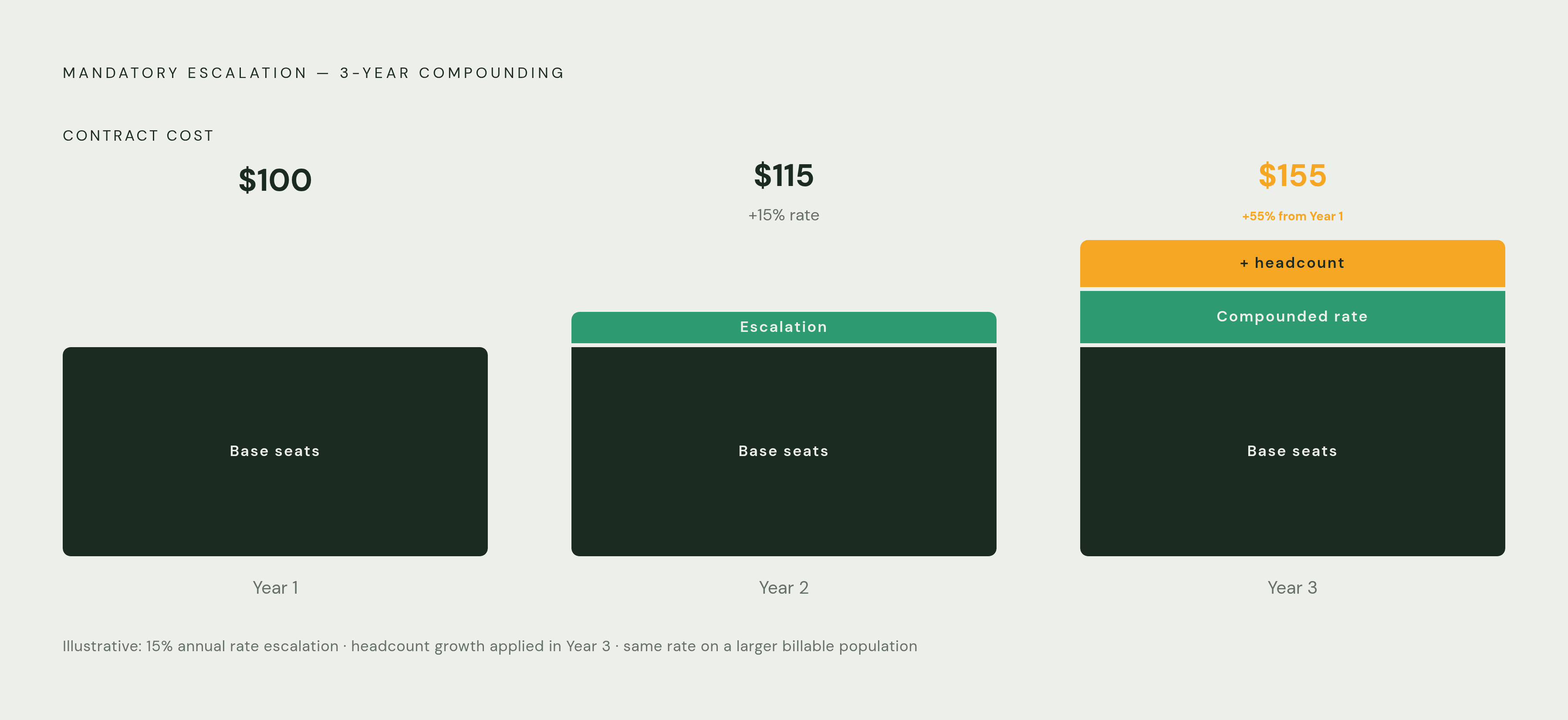
An annual escalation clause can appear as routine language deep in an agreement. A standard form is “pricing shall increase annually by the lesser of X% or CPI”. The operative words are “shall increase”, which make the adjustment mandatory. A buyer may read this as a limit on what the vendor could charge, but it also establishes what the vendor will charge under the stated formula.
Compounding changes the base used for each adjustment. In year one, the buyer pays the agreed starting price. In year two, a fixed escalation rate applies to that price. In year three, the same rate applies to the already increased year-two price. If the team also adds seats, the higher rate applies to a larger billable population.
The duration of the protection is equally important. Language such as “No cap on escalation in Year 5+” leaves later years open even when the initial term looks predictable. A provision allowing increases “at the vendor’s sole discretion, not to exceed CPI” supplies no fixed percentage limit independent of CPI. The negotiating response is to request fixed pricing for the full term or, if escalation is required, a lower starting price that offsets its compounded effect.
Market-adjustment provisions and the cap they can override
Market-adjustment provisions create a separate route for changing prices, outside the clause that controls routine annual escalation. Their triggers can include market conditions, competitive positioning, or the cost of service delivery. When those terms are undefined, the vendor controls the justification for invoking them.
A contractual exception can allow a buyer with a 3% annual cap to face a mid-term or renewal increase described as a “market adjustment”. If the contract permits that exception, the cap is conditional. The vendor need not change the routine escalation formula to seek a larger increase through another provision.
Renewal language can weaken the protection in a similar way. A reference to “then-current list price” allows the next term’s price anchor to shift away from the negotiated starting rate. Tie renewal pricing to the originally contracted price plus a defined escalation formula. That protection also needs language that rules out market adjustments outside the formula or requires both parties to agree in writing before one can apply.
How admin-seat counting turns every new hire into a larger bill than expected
Finance and RevOps forecasts often begin with the payee population because sales reps are the visible users of commission software. Contracts may define the paid population more broadly. Compensation administrators, Finance reviewers, RevOps operators, and approvers can also occupy named seats.
A 20-rep hiring wave may require two or three additional admin seats. If all seats have the same rate, the effective software cost of adding each rep exceeds the advertised per-user price. This is the gap Finance must explain to the CFO when the renewal bill grows faster than the modeled sales headcount. Annual escalation can widen that gap further by increasing the rate charged across both groups.
True-up clauses change when the extra cost becomes visible. An end-of-period reconciliation charges for actual users above the committed count, so a mid-year hiring surge can produce an additional invoice. Before signing, buyers should obtain written definitions covering approvers, read-only viewers, Finance auditors, and integration service accounts. A lower-priced read-only or stakeholder tier is also worth requesting explicitly, rather than assuming every supporting user needs a full-price license.
Auto-renewal terms and the cancellation window that closes before you notice
The agreement renews for another full term, usually 12 months, unless the buyer gives written cancellation or non-renewal notice within the required window. That window commonly falls 30 to 90 days before expiration. The decision deadline therefore arrives before the renewal date and can precede the Finance team’s budget planning for the next period.
The notice requirement may sit apart from the pricing provisions. A review focused on rates and escalation can consequently miss the procedure that locks those terms in for another period. With bundled modules, the buyer may also have to cancel each add-on on its own. ASC 606 reporting, additional connectors, or premium support can renew even when the buyer no longer uses them.
Ramp deals have a separate timing risk, with lower prices in Year 1 and step-ups written into the contract for Year 2 and Year 3. The commitment to those increases can precede a full evaluation of the product. For Finance and RevOps, the operational response is to calendar the cancellation window on the signing date. Using the 90-day mark before renewal as the deadline to negotiate sets a time to review pricing before renewal and before the next invoice arrives.
Add-on pricing for Finance-critical features creates a second escalation layer
The base subscription may exclude capabilities that Finance needs. ASC 606 and ASC 340-40 reporting, payroll connectors, multi-level approvals, and premium support can be priced separately from the quoted seat rate. Each feature left out of the base subscription can add a recurring charge.
Connectors make that separation particularly concrete for Finance teams. Connections to non-primary CRMs, payroll systems, and ERP platforms may be priced per connector per month. Each connector can have its own renewal and escalation terms, so a cap on the base subscription may leave this layer unprotected.
Accounting workflows also increase the cost of leaving. When the platform handles capitalization and amortization associated with ASC 606 and ASC 340-40 reporting, switching can risk disruption to an active amortization schedule. The renewal decision is then about more than migration effort, which gives add-on pricing additional leverage. Before signing, buyers should request a complete inventory of excluded capabilities and current list prices, specifically covering accounting reporting, all payroll connectors, and multi-level approvals.
Minimum commitment ratchets and retroactive repricing after acquisitions
Minimum commitment ratchets separate spending from actual use. The agreement raises the minimum annual spend by a fixed percentage, regardless of consumption or seat growth. A hiring freeze, reorganization, or team reduction does not automatically reduce that obligation.
Acquisition and product restructuring create a different repricing exposure. Broadcom’s acquisition of VMware illustrates the risk of a pricing-model change through the conversion of perpetual licences to subscription pricing. That example shows why protection against model changes belongs in the review. Related exposure includes switching from per-user to per-resource pricing or adding a consumption layer for AI features above a per-seat base.
Minimum commitment ratchets should share the annual escalation limit, while pricing-model changes should require the buyer’s written consent. The agreement should also prohibit reclassification of licensed products because of acquisition or rebranding. Without those protections, the vendor may change the unit it charges for even when the rate on the original unit is capped.
What to actually negotiate before signing a commission software contract
For a Finance or RevOps lead, the following contract requirements form a procurement and legal review checklist. They are standard negotiating asks. The strongest opportunity to secure them is before signing, while the vendor is still competing for the commitment. Auto-renewal and accumulated switching costs can substantially weaken that position later.
First, the contract should fix pricing for the full term or state a defined maximum escalation percentage throughout it. For any increase beyond that limit, the vendor should have to get the buyer’s written consent as well as give notice. Renewal must use the originally contracted price plus the agreed formula and exclude “then-current list price” as a pricing basis. Market-adjustment language should be prohibited outside that formula or require written agreement from both parties.
The contract should enumerate billable user types and distinguish administrative access from reviewing or viewing access. Finance reviewers, approvers, and auditors who do not perform administrative actions are candidates for a read-only tier. This makes the staffing forecast usable as a cost forecast rather than leaving the paid population open to interpretation.
Renewal procedure should be negotiated with the price protections. The notice terms should provide an extended opportunity to act, with written vendor notice of pending auto-renewal well in advance of the renewal date. A separate written exhibit should list every feature left out of the base tier, what it costs now, and whether the base escalation cap applies. The requested language should treat unlisted features as included.
Any minimum-spend ratchet should be capped at the same percentage as annual escalation, with a renegotiation right when active seats fall below the minimum. Acquisition, rebranding, or product restructuring that changes pricing terms should trigger a right to renegotiate or exit without penalty. A vendor that refuses all these protections is making the pricing risk clear before the buyer commits.
How do you avoid paying more for commission software every time you hire a new rep?
The most direct way to avoid hire-by-hire increases is to choose commission tracking software whose billing variable is not users or seats. With per-plan pricing, the bill is based on the number of active compensation plans instead. Adding reps to an existing plan keeps that count unchanged, removing increases tied to headcount at the model level.
That distinction does not make per-plan pricing cost-free at scale. New overlays, new SPIFs, and new team kicker structures can expand the number and complexity of compensation plans. As the number of billable plans grows, the bill can grow too. Buyers should compare how well growth in plans and growth in headcount each reflect what the organization needs from its compensation plans.
With either model, buyers still need to review the renewal and escalation language. Per-seat pricing, however, makes the company’s intended headcount growth a direct source of subscription growth, which adds seat definitions and hiring-related true-ups to the negotiation burden. Finance and RevOps should therefore establish the billing variable before the demo. That choice determines which growth events increase the bill and how much contractual protection the buyer will need.