Why Plan Complexity Is a More Honest Cost Driver Than Seat Count in Commission Software
Plan architecture, not headcount, determines what commission software must handle.

With per-plan commission software pricing, cost depends on the compensation plan architecture. It is a more honest cost model because tiers, accelerators, splits, clawbacks, and renewal rules create the calculation and control burden. For teams seeking commission tracking software that does not charge per user or per seat, the key distinction is whether hiring under an existing plan increases the bill without changing the rules the system must resolve.
Why seat count became the default pricing unit for commission software
Seat count fits the familiar subscription convention. It gives buyers an easy unit to count and vendors an easy basis for a quote. But ease of billing does not make that unit a useful measure of commission work. The number of payees says little about whether a payout requires a flat-rate calculation or several interdependent rules.
The mismatch becomes clear when a sales team grows. A team that doubles its sales headcount under seat-based pricing pays roughly double, even if its plan architecture remains identical. More recipients do not introduce new accelerator logic, clawback conditions, or allocation rules. If seats are a weak proxy, what actually determines how hard commission software has to work?
What actually creates work in commission operations — the anatomy of plan complexity
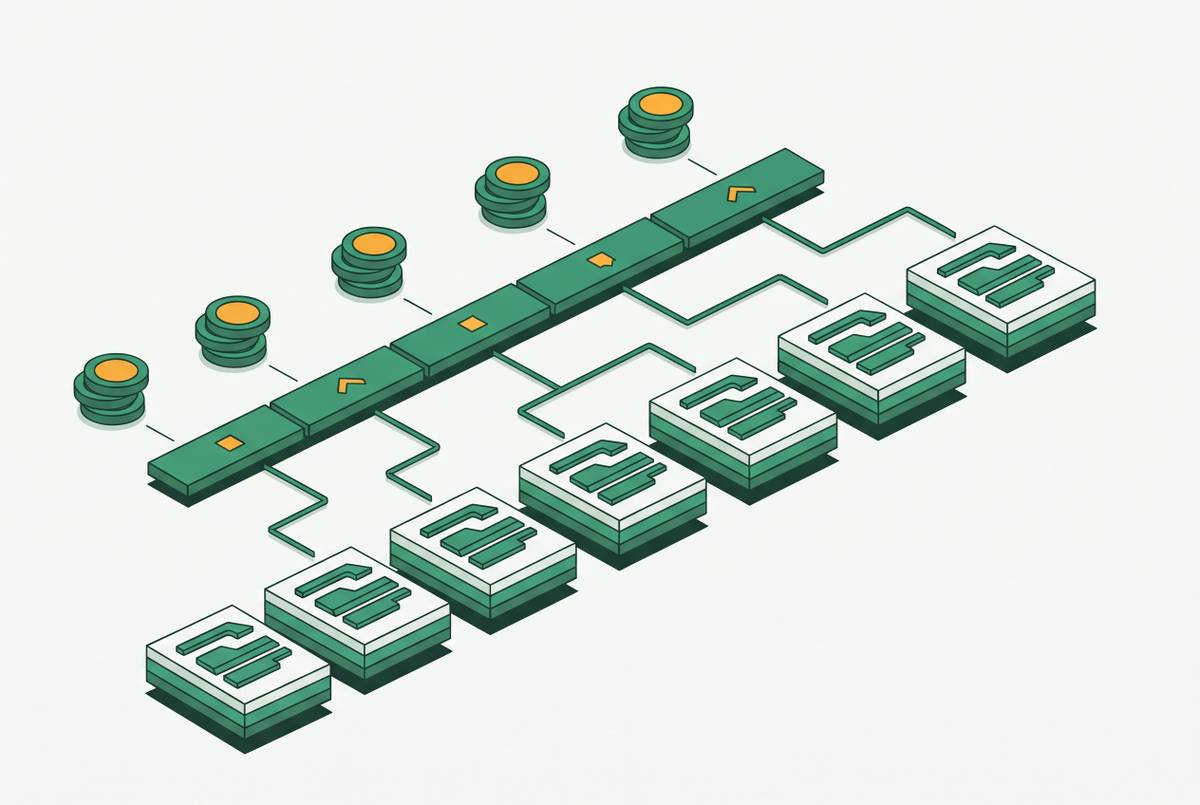
Plan architecture sets how many calculation paths a commission system has to work through. Tiers introduce thresholds, accelerators change rates, and splits distribute credit under rules that may differ by role. These rules accumulate and interact. A standard tiered B2B SaaS structure can motivate reps through clear thresholds, but its nonlinearity also means small forecasting errors can produce significant, unexpected commission expenses.
Retroactive and marginal accelerators expose the distinction sharply. A marginal accelerator uses the higher rate for the portion above the threshold, while retroactive logic changes the rate for earlier production that qualifies. The same deal and rep can therefore produce materially different payouts under different plan wording. Software must encode that fork rather than leave it to a spreadsheet formula negotiated each cycle.
With clawbacks, the calculation stays open past the original pay period. The system has to match a payout to a future contract event, so the calculation thread stays open until the clawback condition is settled. Overlays create parallel threads when a sales engineer, SDR, and AE receive partial credit on the same deal under different rates, quota baskets, and potentially different clawback windows. SPIFs add time-bounded rules that must remain separate from the base calculation.
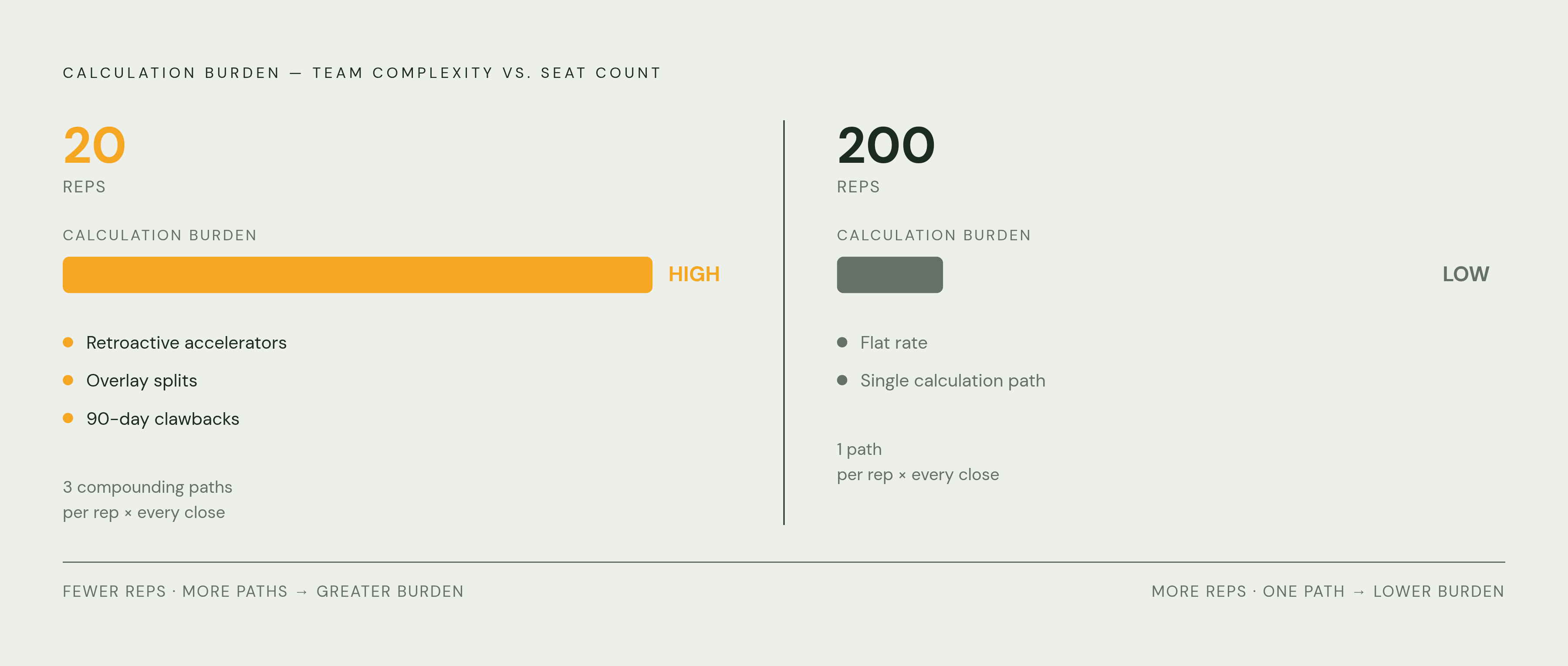
Component sprawl pushes these interactions further. A “slot machine” plan containing base pay, commission, a quarterly bonus, an MBO, a SPIF, and a team kicker is not a coherent plan merely because its components fit in one document. Each layer adds paths to work through for each rep in each period. Consequently, a 20-rep team with retroactive accelerators, overlay splits, and 90-day clawbacks can generate more calculation burden than a 200-rep team on a flat rate.
Why spreadsheet failures cluster around plan complexity, not rep count
Spreadsheet failures follow those branching rules. Nonlinear logic gives a small formula error room to compound across a period before anyone catches it. A deal may be double-counted across two reps’ ranges, a clawback may go unapplied because nobody tracked the customer’s churn date, or a tier threshold may use the wrong time period. None requires a large sales team. Each arises from a rule or relationship that the commission process failed to preserve.
The characteristic failure is therefore not necessarily dramatic. It is a series of small mistakes that survive until reconciliation, a dispute, or a later adjustment exposes them. Without access controls, an audit trail, and period locking around the commission process, historical numbers can also drift after close without a usable record of who changed what or why.
That distinction keeps the critique proportionate to the problem. A small team on a flat commission rate can operate in a spreadsheet for years without trouble. Its calculation has few branches and little history to revisit. The breaking point arrives when plan architecture introduces nonlinearity and persistent obligations.
How plan complexity compounds during period close for Finance and RevOps
Finance and RevOps must resolve disputed tier thresholds, reconcile overlay splits, and account for open clawback windows before handing reviewed results to payroll. The treatment of a future clawback window in the current payout must be clear even while the window remains open. The close becomes a coordination problem as well as a calculation task.
Overlay plans make that dependency particularly visible. One closed deal can remain in the reconciliation queue while the sales engineer, SDR, and AE calculations are resolved under their respective rules. Any unresolved thread can hold up approval. More rules create more points at which Finance and RevOps must establish agreement.
Without a single-logic engine pulling from the CRM and applying one set of rules, that agreement becomes a recurring “your number doesn't match my number” reconciliation between sales and finance. Discrepancies then consume both calculation time and trust. Encoding plan logic in governed software accelerates arithmetic and addresses the source of that disagreement. The most time and work can be saved where people once had to work out how to apply nonlinear rules over and over.
ASC 340-40 makes plan architecture a direct input to financial reporting, not just operations
ASC 340-40 extends the consequences of plan design into financial reporting. How commissions are structured affects how eligible costs are capitalized and amortized, so accounting work may remain after the rep is paid. The amortization period depends on contract terms, anticipated renewals, and whether commissions are re-earned on renewal at a similar rate.
Different rates can create distinct capitalization pools. New-logo, expansion, and renewal commissions may each need their own treatment, with schedules based on how the contracts relate to one another. A flat-rate structure is simpler, though the terms of the contracts still set the accounting rules. The additional burden is tracking those distinctions over time after calculating the initial award.
SimilarWeb’s FY2024 20-F shows that the company amortizes initial contract commissions over three years and renewal commissions over the renewal term. Its disclosure explains that renewal commissions are not commensurate with initial commissions because the rates differ substantively in proportion to their respective contract values. The rate relationship changes the accounting treatment. A payee count reveals none of that work.
Cintas’s FY2026 annual report discloses a nine-figure amortization expense related to capitalized commissions. An expense that large makes commission accounting a key part of choosing a platform, even if it might otherwise seem like a minor reporting feature. Even at smaller scale, a 30-rep enterprise SaaS team with differentiated new-logo, expansion, and renewal rates can have more accounting complexity than a 300-rep team on a flat rate. Contract and plan architecture explain the difference.
How the market's own pricing structures inadvertently confirm the complexity argument
The market’s pricing behavior acknowledges the weakness of a seat-only model. Per-seat pricing provides a visible commercial unit, but more complex quotes also take plan complexity into account. Xactly Incent uses quote-based pricing tied to both payee count and plan complexity.
Salesforce’s published account of its internal migration describes tens of thousands of sellers, scores of unique compensation plans, and billions of commission-based data points. Those are distinct dimensions of a deployment. Seller count establishes reach, while unique plans and data volume describe work that a simple seat tally leaves unexplained.
A hybrid quote can take that difference into account and still charge by the seat. In effect, complexity becomes an adjustment to a headline unit that cannot fully explain the cost on its own. This is the tension in the convention. If a vendor needs to understand plan architecture before it can price a deployment accurately, that architecture is already functioning as a cost driver.
How does per-plan pricing avoid charging more for every new rep?
Instead of charging for every additional payee, it ties the subscription to the compensation plans the system supports. Under that model, doubling headcount under an unchanged plan structure does not increase the plan-based charge. Growth in recipients is separated from growth in rules.
That distinction needs a precise commercial definition. Counting plan documents alone would be a weak measure if each document could contain unlimited, materially different calculation paths. A complexity-aware per-plan model reflects additions such as a clawback window, an overlay role, or a differentiated renewal rate because they increase the work being supported.
The resulting cost signal is more useful to Finance. Hiring under the same structure need not raise the software bill, while changes to compensation design have a clear effect on cost. Total cost is then more closely tied to plan decisions that Finance can weigh, with less weight on sales hiring alone. This also gives plan architects a reason to ask whether an additional component earns its keep. A plan nobody can explain cannot reliably steer behavior.
How to evaluate commission software when plan complexity is the right measuring stick
For buyers, the lesson is to start with plan architecture before requesting prices. Map the tiers, marginal and retroactive accelerators, overlay splits, clawback windows, and differentiated new-logo and renewal rates already in use. That map defines the work the platform must handle. Headcount remains relevant to a seat-based quote, but it should not substitute for a specification of the calculations the system must perform.
The best test of how the system works uses the actual messiest accelerator plan. Check whether retroactive and marginal logic are separate rules that can be selected or need custom formula work. Ask how mid-period plan changes avoid retroactively altering locked pay periods. Then test whether one deal can credit multiple roles under different rates and quota baskets, with every thread reconciled at close.
Ask whether ASC 340-40 / ASC 606 capitalization tracking comes standard or requires a separately scoped add-on, and what that scope includes for multi-rate plans. Establish who counts as a user, including whether the quote covers payees alone or also admins and approvers. For per-plan pricing, establish what constitutes an additional billable plan or component. The comparison is only useful when both the calculation scope and billing unit are explicit.
One or two flat-rate plans and a small headcount can remain suitable for a spreadsheet or free calculator. Once a plan has nonlinearity, testing real plan data in a sandbox before signing a contract gives a better test than a polished demonstration. It exposes the system to the buyer’s actual tier logic, split rules, and clawback configuration.
A parallel run provides the final operational safety net. Running the new system beside the existing spreadsheet for a cycle reveals discrepancies between their results before they reach payroll and makes the transition auditable. The evaluation then rests on the rules the system actually resolves, rather than the number of people shown in a pricing calculator. That is the buying standard a complexity-based cost model should meet.