Timestamp and User Attribution Standards That Separate Real Commission Audit Logs From Basic Change History
Five required fields let Finance reconstruct any disputed commission payout.
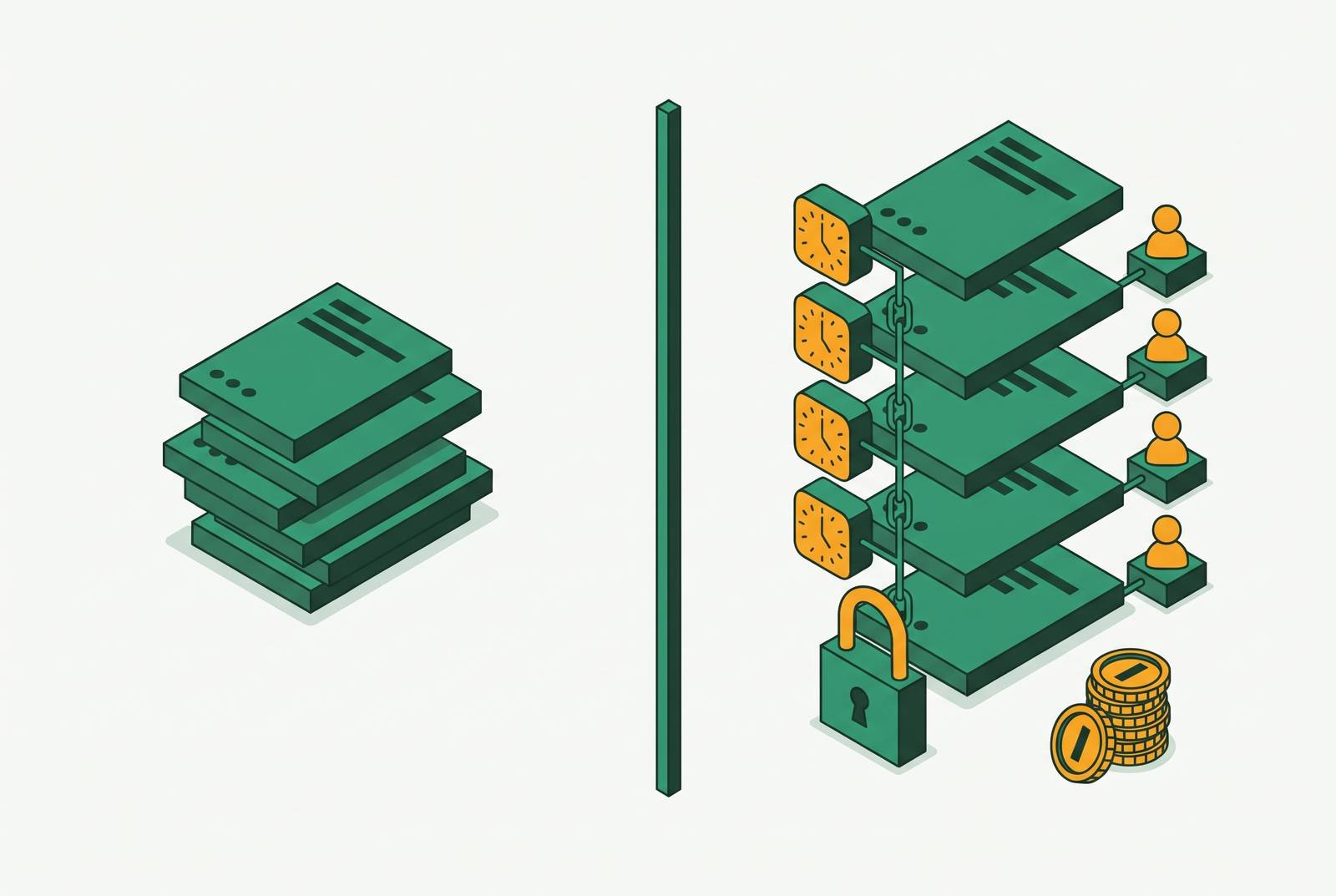
Commission software with locked pay periods and audit trails must block edits to approved periods and preserve who changed each value, when, under which plan version, and with whose approval. This article defines the timestamp and user attribution standards that separate that record from basic change history. A defensible log supports reconstruction of a disputed payout, while later adjustments leave the approved record intact.
Why a change history and a commission audit log are not the same thing
A rep disputes a payout, and Finance opens the commission platform’s change history. The record shows that a number changed, but not the prior value, the person responsible, or the approval behind it.
That gap separates change history from an audit trail. The requirement is not simply to keep logs, but to keep operation-level, data-specific, attribution-complete records that reveal tampering. A label such as “modified” cannot show whether someone changed a rate, reassigned credit, or entered an adjustment. A defensible audit record lets Finance reconstruct who changed what and why.
Why commission data carries structural audit risks that generic financial logs do not
Commission records depend on source data that can change after a calculation. Deal amounts get revised, opportunity owners change, close dates move, and products get reclassified. The source is not a fixed document. If the commission system reads the live CRM record at payout time rather than a snapshot from calculation time, the same deal can produce a different figure retrospectively, without a commission log entry explaining the difference.
The system must keep a three-layer record with the raw import exactly as received, the normalized transaction used by the calculation engine, and the current source value. Comparing these layers exposes changes made after commissions were locked. The normalized transaction establishes what the engine actually calculated, while the raw import preserves what arrived from the CRM. The current value then makes subsequent mutation visible rather than allowing it to overwrite the historical basis.
If March commissions have been paid and Finance discovers an underpayment in May, the approved March record must remain intact. The correction belongs in a May adjustment referencing March, with its own audit entry. A timestamped approval and a locked pay period keep a correction from changing the approved record. An accounts-payable source document stays fixed after posting, while the commission record must be protected from later changes to both the source and the payout.
The five fields every compliant commission audit entry must contain
Authenticated user identity. Attribution must identify the individual responsible for an action, rather than stop at a shared account, service account, or API key. “Admin” does not establish individual accountability. In commission workflows, a manual adjustment or plan override must name the person who entered it and the person who approved it in separate attributed records. Where automation acts under a service account, the record must retain the link to the human who directed the action.
Timezone-aware timestamp from a synchronized clock. An event needs an unambiguous time so that its position in a sequence can be established across systems. Local time alone cannot supply that reference. For commissions, the timestamp establishes whether an override preceded payroll cutoff, whether approval preceded the payout run, and when a pay period closed. Synchronization keeps clock drift from making those events appear in a different order in different logs.
Before-and-after field-level values. An audit record must identify the precise operation and preserve the state before and after it. A general edit flag is not enough. For commissions, the relevant evidence includes the prior and new rate, accelerator threshold, or quota value, rather than a statement that the compensation plan changed. That detail lets Finance explain a disputed calculation without reconstructing the edit from memory.
Plan rule version identifier. A calculation needs the governing rule set as well as its inputs and output to be reproducible. The entry must preserve the version active at calculation time so that an auditor can examine the rate tier, accelerator, SPIF, or clawback rule used. Locking a period therefore seals both the calculation inputs and the plan version that produced the payout.
Cryptographic integrity proof. Detailed evidence is useful only if later alterations can be detected and the original record protected. Immutability and tamper-evidence serve different purposes. Append-only, write-once storage prevents edits, while hash chaining supplies evidence of alteration. For a commission record, both protections are needed to preserve the calculation and approval history rather than merely assert that the history is complete.
What the timestamp field actually has to encode, and why the detail matters
The timestamp specification is concrete. Each entry must encode the date, the time to at least the second, and an explicit timezone designator. UTC is the safest standard for multi-entity or internationally distributed teams. A value such as “14:32:07” lacks enough context to place an event reliably against records from another system. The clock supplying the timestamp must also be synchronized, with NTP synchronization expected.
Precision and synchronization solve different problems. Second-level precision records when an event took place in enough detail for the commission workflows described here, while synchronization keeps the systems on the same time reference. If the commission clock drifts from the CRM clock, an override can appear before cutoff in one record and after it in another. The discrepancy undermines the sequence even when both entries include dates and timezones.
MiFID II requires microsecond timestamps for order lifecycle events. SOX and SEC Rule 17a-4 do not impose that level of precision on commission records, for which second-level precision with timezone context is the established baseline. The distinction keeps the specification proportionate to the event. In cross-system reconciliation, that baseline lets Finance check whether a plan amendment came before a deal’s close, whether an override approval came before payroll submission, and whether a clawback fell within the time allowed by its contract.
How the approval chain becomes part of the audit record, not a separate process
COSO’s February 2026 guidance shifted the evidence standard from point-in-time screenshots toward continuous control monitoring through timestamped, attributed records tracked over time. A screenshot establishes only a momentary state. It does not establish that a control operated consistently, so an approved commission statement PDF cannot substitute for the underlying approval history. The audit record must show who approved the statement, when, with what authority, and in what system state.
The record needs to identify who reviewed the statement, its state at review, and whether anything changed between calculation and approval. Rep acknowledgment, manager sign-off, and Finance lock each need their own attributed, timestamped entry. Together, they establish the chain of custody.
The lock gives that chain an enforceable boundary. Once a pay period is locked, the system must block retroactive edits and require later adjustments to reference the locked period through new entries. A manager’s override after Finance review must have its own event showing who made it, with the reviewed record left intact. Approval history and period locking work together because one establishes authorization while the other preserves the authorized state.
Retention periods and queryability — what compliant storage actually demands
Retention depends on the framework that applies to the organization and record. SOX calls for financial data to be kept for seven years, including public companies’ commission records that fall within its scope. SEC Rule 17a-4 sets a six-year minimum for broker-dealers, with the first two years in hot or warm storage.
HIPAA requires security documentation to be kept for six years under 45 CFR § 164.316(b)(2)(i), and that standard is applied to audit logs in practice. For commission software generally, the retention range is three to seven years depending on jurisdiction and applicable tax and employment rules. The evaluation must check how long records are kept by default and whether the settings can meet the minimum time the law requires.
Retention alone does not establish accessibility. A seven-year archive that takes a week to retrieve leaves a request waiting, while searchable records can be ready when requested. Queryability requires indexed fields, including user ID, timestamp, record or document ID, and action type. Those indexes let the compliance team find activity for a given rep and date range without asking engineering to parse a flat file.
The practical target is an export in minutes. A flat CSV provided on request does not, on its own, show that records have indexed access or meet the within-24-hours accessibility standard that mature regulatory frameworks expect. The evaluation must establish retrieval performance as well as the date on which records are deleted.
Three 2026 regulatory developments that tighten these standards beyond their historical baseline
COSO published “Achieving Effective Internal Control Over Generative AI” on February 23, 2026. For commission systems using AI-assisted plan extraction or anomaly detection, timestamped and attributed logs form part of the ICFR evidence set. Evidence must show a control’s operation over time.
The SEC announced its dedicated SOX enforcement group on March 16, 2026. The development signals increased scrutiny of firm-level quality controls and AI-touched internal controls. Commission workflows using automated rules or AI-assisted crediting fall within that scrutiny. Their audit evidence must account for the decisions affecting financial results and the final payout figure.
In April 2026, the Federal Reserve’s SR 26-2 guidance took the place of SR 11-7. It treats documented development, independent validation, and ongoing monitoring as sound-practice principles for models influencing financial decisions. These are not enforceable requirements.
For commission platform evaluators, AI-assisted functions introduce a separate decision record. The commission calculation log, the CRM integration event log, and any AI-influenced crediting decision are three layers of evidence that are separate but chained together. A single export cannot substitute for those distinctions. Each layer must preserve its role in explaining how source data and decisions produced the payout.
What to test in commission software with locked pay periods and audit trails
The first step in the evaluation should be a manual override. The vendor should show separate records naming the individual who entered it and the individual who approved it, replacing generic attribution to “admin” or a service account. Export an entry and inspect the timestamp for an explicit timezone and second-level precision. Then ask whether the clocks use NTP synchronization, since formatting alone cannot establish a reliable time reference.
Make a small change to a rate tier or accelerator threshold and inspect the resulting entry for the prior and new field values. Ask whether historical calculations remain linked to the plan version active when they ran, even after the plan is amended. A “plan modified” entry fails this reconstruction test.
The integrity test must cover what people can do with privileged access as well as in ordinary use. Ask whether logs use append-only, write-once storage with hash chaining, and whether an administrator can edit an entry. Request the tamper-evidence mechanism specifically. Then ask whether a locked, approved pay period can be edited retrospectively or whether every adjustment requires a new entry referencing that period.
Ask how long it takes to export entries for a specific rep, date range, or action type, and whether the compliance team can do so without an engineering ticket or custom query. Check the default retention period and whether its settings can meet the legal requirement that applies. SOX-covered entities need the seven-year period.
The final limit is configuration risk. A platform can accurately log an incorrect payout if the plan rules were misconfigured. An audit trail proves what happened. Human review and approval therefore remain structural requirements. Locked periods preserve an approved record. They do not eliminate a rep’s right to question the calculation or replace the review needed to resolve that question.